Tuesday, May 15, 2007

Excowsions: Going to Boeing

A lovely Friday (this past one) in Seattle. Balmy springy weather, sunny bright blue skies, a stomach full of pancakes from Julia's of Wallingford, and a rental car with a full tank of gas. Could there be (in my Chandler Bing voice) a more perfect day?

Yes! Yes, there could be. Head on down Route 5 towards Seatac airport and swerve off (don't forget your turn signals) onto exit 158 and head for Boeing's Museum of Flight. I've been to Seattle a bajillion times and every time I pass the big billboard with the SR-71 Blackbird soaring across the sky and narrowly missing Air Force One I say to myself "Self, you oughta go to the Museum of Flight." Well, Friday was the day!


The Museum of Flight is built in a giant horseshoe around the original Boeing "Red Barn" aviation factory, which provides a dandy historical context from the age of the Wright Brothers to the Starship Voyager. Oh wait, it doesn't go up quite that far, but there's still plenty of cool stuff to see. Right from moment one when you pull your rental car into the space-age parking lot there's stuff to look at. See, somebody parked their planes right on the front lawn! I always get in trouble when I leave my toys on the lawn at home:


Plop down your fourteen bucks at the front desk to get a dashing wristband that gives you admission to the entire museum. But don't rent that audio tour! The sign says "Audio tour rental, $5.00"...but when I asked to rent one they pulled out a credit card machine and said "And we'll also need a credit card to take a deposit on the audio tour module." Well, okay, sez I, slowly taking out my MasterCow. Then desk clerk runs my card through the machine and hands me back the slip to sign on the deposit for a total of

wait for it

Six hundred dollars.

Uh uh. No way. Nuh-huh. I'm not signing that. The clerk explains that this is just a deposit in case the module is lost or broken, but I'm not feeling at all confident in carrying around a six hundred dollar plastic phone, especially since my hooves are full of my camera—and I'm feeling a little paranoid since I put a crack in my laptop screen a couple days before. I've done enough audio tours in museums (for example, the excellent audio program in London's Cabinet War Rooms) and have never been asked to put down this kind of moolah as a safety. "I'm sorry, I don't think I want this," I explain. "I'm kind of a butterfingers." She tries to convince me that the thin lanyard strung from the end of the plastic phone will keep me from dropping it, but I fix her with a stern stare and say "It's more difficult with hooves." In the end she grumbles a bit and holds me up for another five minutes while she voids my receipt, tears up the credit card slip, and refunds my five dollars. I head off for the museum feeling safer if a little worked up. Sitting on the end of the counter is a placard promoting the audio tour. It lists a "fifty dollar cash deposit required." Huh. Looks like some contradiction there, huh? I might have put down fifty dollars cash deposit for a good audio tour and not been too devastated if I accidentally sat on the phone. But six hundred? Why, that's two hundred copies of 52. That's four years worth! I will not spent four years in this museum! Later when I get home I do some research on the Museum of Flight's website and find that I probably just shoulda downloaded some of their podcasts, but whatdaya gonna do? What did I do? I fired up my Star Trek soundtrack playlist on my iPod and stepped into the museum.

The six hundred dollar audio tour, however, was the only disappointment of the trip. While not as massive or as comprehensive as Washington's Smithsonian National Air and Space Museum (which I was lucky enough to visit last May around this time), it's still a wonderful museum.


Start your visit in the original Boeing building, the "Red Barn," which features a great early history of Boeing and Seattle/Pacific Northwest flight and aviators, plus a dandy sideroom exhibition on the Wright Brothers. Peer in historic Boeing offices, see early planes in construction, plus a whole buncha plane parts that I wouldn't be allowed to play with because I'd probably wind up with some nuts and bolts left over. The room is bright, airy, and sunny—a perfect exhibition space—and there's something to see everywhere you turn. Look, here's a Sopwith Camel just my size. But they've got it strung from the ceiling so I can't get in it and soar about. Curse you, Red Baron!:


Move from here into the large two-story Personal Courage Wing, both floors a very thorough and comprehensive history of aviation during the two World Wars. There's a lot of great planes and models to look at, plus plenty of multimedia including film and radio to give you background into the lives of the fighters and fliers of the World Wars. The equipment and machinery are amazing and fun to look at, but most touching was an exhibition of photographs of National Medal of Honor winners—the men and women behind our victories—accompanied by their own words. Very touching and a vital addition to learning the history. It made me reach for my little monogrammed handkerchief. See, already I have things in all my hooves; I surely woulda dropped that audio tour phone!

Of course, don't miss all the cool planes:


And there's even a small display that includes a Steve Savage, Balloon Buster comic book. Boy, am I sure glad I didn't buy a balloon in the gift shop:


From World War II step into the modern age of aviation in the massive and aptly named Great Gallery, which has seventy-eight, count 'em, seventy-eight planes and plane replicas in its hangar-sized exhibition space:


...including the Lockheed Blackbird...yes, that's the X-Men's plane. Thankfully, Gambit was nowhere to be seen:


...the front half of a commercial jetliner...hey, this must be that plane from Lost!...


...and didn't I see Tattoo and Saruman flying this one in The Man with the Golden Gun?:


Some of the planes have simulators set up so you can fly 'em. Look! I'm taking the highway to the Danger Zone! Goose! Goose!:


Don't forget to stop in the gift shop (I bought a souvenir pencil). But even after you're done with the big Boeing complex, you ain't done with the Museum of Flight yet, buddy! Oh no no no no no! Dart across the curiously named four lane highway that is East Marginal Way and if you make it, you can tour an outdoor exhibition yard with some of the Museum's biggest-name attractions. No, not Orson Welles, but something even bigger: Air Force One!:


If Harrison Ford isn't busy battling terrorists on board, you can step inside AF1 and see the President's flying palace in all its 1970s glory, including the conference room...:


...the communication station...:


...and the Presidential biffy. Hey, if I was designing this, I woulda put the presidential seal on the toilet seat:


That ain't the end of the fun! Step across the tarmac and come face to pointy nose cone with the Barry Allen of planes, the Concorde!:


I was very surprised at how narrow and small the Concorde was. There's only four seats across in both coach and the forward first class section, and even for slender slender me it's a sideways squeeze down the aisle. I guess if you're riding the Concorde, you're riding it for speed and not luxury. But man, are its bathrooms aerodynamically designed for speed!:


Also, exactly what you'd expect from a major museum: placards relating rumors:


But I kid Rod Stewart. Seriously, if you're in Seattle, don't miss a grand day out—head on down to the Museum of Flight and come away with your spirit soaring. Unless you dropped your six hundred dollar audio tour, in which case the only thing flying will be dollars out of your wallet.


Bye, Rory.

Rory Gilmore


Monday, May 14, 2007

A Wodehouse a Week #3: The Heart of a Goof

A Wodehouse a Week banner
'You haven't seen a novel called The Man with the Missing Eyeball anywhere about, have you? I'll swear I left it on one of these seats when I went in to lunch.'

'You are better without it," said the Sage, with a touch of austerity. 'I do not approve of these trashy works of fiction. How much more profitably would your time be spent in mastering the contents of such a volume as I hold in my hand. This is the real literature.'
—from The Heart of a Goof by P. G. Wodehouse

A Wodehouse a Week banner"What are you reading these days?" people asked me. Well, mostly Snuckles, and he never can remember the answer from one day to the rest. But, when I'm out and about on the town with book people, like I was with the good folks from Amazon last week (dining at the fabulous and posh Cascadia Restaurant, home of the delicious lobster-crushed potatoes), that sort of question is likely to come up: "What are you reading these days?" Well, I lowered my lobster-potatoed fork and stared fixedly across the table at them and announced "I am reading my way through P. G. Wodehouse, book by book, one a week." Then everyone says something along the lines of "Oh, that must be fun. How far along are you? How long will it take you?" When I explain that I am on week three and I have another two years to go, they blink and drop their famous miniburgers and exclaim in consternation and uproar: "That's quite an undertaking! You'll never finish it." Sigh.

So here I am at week three, with umpty-umpt weeks to go, but I must tell you this project is a pure pleasure. I've gotten away from straight book-reading in the past few months and it's a delight to dive into a book a week that is light and entertaining and funny and pleasant, a book that has me chuckling out loud on the subway and pulling little Post-It™ tabs to mark especially delightful phrases that tickle my fancy. Check back again in forty-nine weeks or so and see if I still feel the same, but I've gotta be thinking that bar a serious overload of fun, I'm going to be having a boatload of a good time doing this.

Why, look at week three's offering of The Heart of a Goof (1926), a collection of nine short stories (some of them interconnected), all on golf, a subject that is not only not near and dear to my heart but which I actively run away from whenever any of my plus-foured fuzzy pals step up to me with clubs in hand and ask me to go the back nine with them. (I'm lookin' at you, Walt the Sporty Cow). My idea of sport is watching Bend it Like Beckham on TV with a big bowl of pizza rolls by my side, and aside from sussing out that golf is the sport with the long sticks and the dimpled white balls and remembering that Auric Goldfinger is a terrible cheat at it, I know very little about it. But it's one of Wodehouse's favorite sports and one of his favorite to write about—he seldom speaks about other English sport like football (that's soccer to you and me), horse racing (leave that to Dick Francis) or darts, and even quintessentially British sport like cricket and rugby only really pop up in depth in his early Wrykyn and other "Boy's Own" type-school stories like The Gold Bat or The Pothunters. But golfing, my my my, he does love the sport, and it shows. Wodehouse writes about golf with expertise but not technicalities, and more important, he writes about it with humor and passion. Don't be afraid if, like me, you know little about the sport. About all that's essential to understand is that a) it is as important as life and love itself, and b) the lowest score wins, the knowledge of this giving a funny undertone to Wodehouse's description of a doting though clueless mother speaking of her son's golf game:
'Rollo is exceedingly good at golf," proceeded Mrs Podmarsh. 'He scores more than a hundred and twenty every time, while Mr Burns, who is supposed to be one of the best players in the club, seldom manages to reach eighty. But Rollo is very modest—modesty is one of his best qualities—and you would never guess he was so skilful unless you were told.'
Well, maybe you need to know one more thing: to P. G. Wodehouse, golf is love. With only a few exceptions these tales relate stories of avid golfers winning their ladies fair (themselves usually enthusiastic linkswomen) through showing their courage and prowess on the links. Golf as a metaphor for love? Certainly odder things have been done in fiction, and Wodehouse makes it all so wonderful, joyful, and convincing that it puts a scheme in my little bean-filled head to get out there with my clubs and spiky shoes and practice practice practice until I get my handicap squared away and then Keira Knightley will quite fall in love with me. Well, it doesn't quite work that way in the real world, but don't you wish it did?

Commander McBraggLike an earlier collection of golf tales, The Clicking of Cuthbert (which of course—no pun intended—I'll get around to reviewing one of these weeks), The Heart of a Goof consists of stories told by The Oldest Member, the venerable Greek chorus of the golf club, who knows all, sees all, and very definitely tells all. Spotting a hapless golfer at the top of every story, he takes him by the arm, plops him down in a chair, and relates to his reluctant audience a short saga of golf, life, and love. Remember those wonderful Commander McBragg cartoons where the Commander would sideline a member of the club to tell a tall tale? Well, that's the Oldest Member to a...heh heh heh...tee...and his hapless victim audience hasn't a chance of escaping the telling:
'But you will, no doubt, wish to heart the story from the beginning.'

The young man rose with the startled haste of some wild creature, which, wandering through the undergrowth, perceives the trap in his path.

'I should love to,' he mumbled, 'only I shall be losing my place at the tee.'

'The goof in question,' said the Sage, attaching himself with quiet firmness to the youth's coat-button, 'was a man of about your age, by name Ferdinand Dibble. I knew him well. In fact, it was to me—'

'Some other time, eh?'

'It was to me,' proceeded the Sage, placidly, 'that he came for sympathy in the great crisis of his life, and I am not ashamed to say that when he had finished laying bare his soul to me there were tears in my eyes. My heart bled for the boy.'

'I bet it did. But—'

The Oldest Member pushed him back gently into his seat.

'Golf," he said, 'is the Great Mystery. Like some capricious goddess—'

The young man, who had been exhibiting symptoms of feverishness, appeared to become resigned. He sighed softly.

'Did you ever read "The Ancient Mariner"?' he said.

'Many years ago,' said the Oldest Member. 'Why do you ask?'

'Oh, I don't know," said the young man. 'It just occurred to me.'
There are stories in here about magic plus fours, a tournament battle for the ownership of the perfect English butler, timid men finding the gumption to fold the woman of their dreams in their tweeded arms on the seventeenth green, and young children scolded by their mother for not holding a mashie correctly. Wodehouse has a lot of fun here, and it shows. How can you resist a book whose dedication reads "To my daughter Leonora without whose never-failing sympathy and encouragement this book would have been finished in half the time," an introduction which suggests that book critics need to publish their golf handicaps aside their reviews of the volume and thus be judged whether they are worthy or not to critique it, and even a lovely bit of self-reference, meta before meta even came along: the book that the Oldest Member is reading in the section I quote at the very top of this post is a masterpiece of golf indeed: we are told it is titled Wodehouse on the Niblick. This is an early collection from the twenties and it's charming more often than it is laugh-out loud, but there are still plenty of funny passages:
'I can stand a lot, but pie-faced Spelvin tries human endurance too high.'

'He is not pie-faced,' said Jane, warmly.

'He is pie-faced," insisted William. 'Come round to the Vienna Bon-Ton Bakery tomorrow and I will show you an individual custard-pie that might be his brother.'
Really, where would the acting career of Hugh Grant be without the influence of lines like that?

He understand the passion players have for the game—and not necessarily gentle loving passion:
'I wish to goodness I knew the man who invented this game. I'd strangle him. But I suppose he's been dead for ages. Still, I could go and jump on his grave.'
...and how love brings golfers together...or is that how golf brings lovers together?:
Barbara squeezed his hand lovingly.

'Don't worry, precious," she said soothingly. 'It will be all right. I am a woman, and once we are married, I shall be able to think of at least a hundred ways of snootering you to such an extent that you'll be fit to win the Amateur Championship.'

'You will?' said Ferdinand, anxiously. 'You're sure?'

'Quite, quite sure, dearest,' said Barbara.

'My angel!' said Ferdinand.

He folded her in his arms, using the interlocking grip.
or these absolutely sublime couple paragraphs:
'Oh, Mary! Mary!' he breathed to himself as he swung.

You who squander your golden youth fooling about on a bowling-green will not understand the magic of those words. But if you were a golfer, you would realize that in selecting just that invocation to breathe to himself Rollo Podmarsh had hit, by sheer accident, on the ideal method of achieving a fine drive. let me explain. The first two words, tensely breathed, are just sufficient to take a man with the proper slowness to the top of his swing; the first syllable of the second 'Mary' exactly coincides with the striking of the ball; and the final 'ry!' takes care of the follow-through. The consequence was that Rollo's ball, instead of hopping down the hill like an embarrassed duck, as was its usual practice, sang off the tee with a scream like a shell, nodded in passing Mary's ball, where it lay some hundred and fifty yards down the course, and, carrying on from there, came to rest within easy distance of the green. For the first time in his golfing life Rollo Podmarsh had hit a nifty.
A Wodehouse a Week #3: The Heart of a Goof


I have just read The Heart of a Goof in the Penguin paperback edition, which features a dandy Ionicus illustration of a plus-fours, tweed-capped foursome teeing up while a pair of lady golfers wait rather impatiently in the background, but I have two other editions of this book in my collection: a rather non-descript hardcover British reprint published by Barrie & Jenkins in the late seventies (the dull uniform brown typography cover on the left) and a volume in the new uniform Everyman Library reprint in the Complete Wodehouse project (published by Overlook in the US). I've got almost all of these lovely Everyman reprints to date, and this one is one of a selection that Father Christmas brought me while I was on my London holiday this past year, and now that I've re-read the book for the first time in many years, I've got to say "Ta very much, big guy! What a wonderful book to have brought me for Chrimble!" You can get the Overlook hardcover edition of The Heart of a Goof by clicking on the Amazon.com link to the right, and there are many other easier-on-the-change-purse options for older, out-of-print paperback editions available through third-party sellers on Amazon as well. It's the perfect pick-me-up between rounds or a lovely refresh at the nineteenth hole. Even if your golf balls are red and yellow and you're putting through a windmill.


Sunday, May 13, 2007

Today in Comics History, Mother's Day: A Mother's Day Poem Upon Reading Avengers #186

This is an expanded and updated version of a post originally published May 14, 2006.

In honor of this Mother's Day
A little bull would like to say

Tho' I don't know my own real mother
I love her lots just like no other

And hope wherever she may be
She misses, cares for, and loves me

But if a mom I had to choose
Someone to sing with quiet moos

I think I'd pick take a second look
At a mom from a comic book

There's lots of moms in comics' world
Franklin's is the Invisible Girl

Sue and Franklin

Hippolyta made a clay daughter
Mera's kid was underwater

Mera and Aquababy

Tito Bohusk can't ignore
His mom is Angel Salvadore

Tito and Angel

Even Catwoman had a kid
One year later, guess what she did

Catwoman and Kittenl

And if you wonder where Clark went
He's in Kansas to see Ma Kent

Clark and Ma Kent

But as I've thought over and over
I think I'd have to go with Bova.

Bova!

She'd keep me comforted and fed
She'd tuck her little bull in bed

She's nurturing and oh so fonda
Kids (You can't blame her for Wanda)


Of love her heart would be so full
She'd surely hug this little bull

Hot soup and kisses on my nose
(A mom should be quite good at those).

Bova!

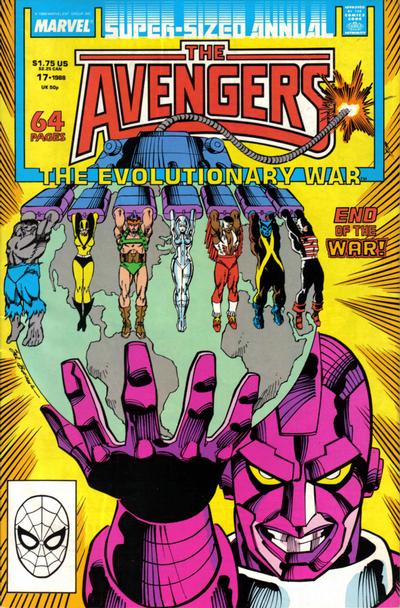
So Bova, come from Wundagore
There is no more Evolutionary War

Avengers Annual #17

But either way I'd like to say
To all moms: Happy Mother's Day!

Ten of a Kind: Architecture attack!


(More Ten of a Kind here.)


Saturday, May 12, 2007

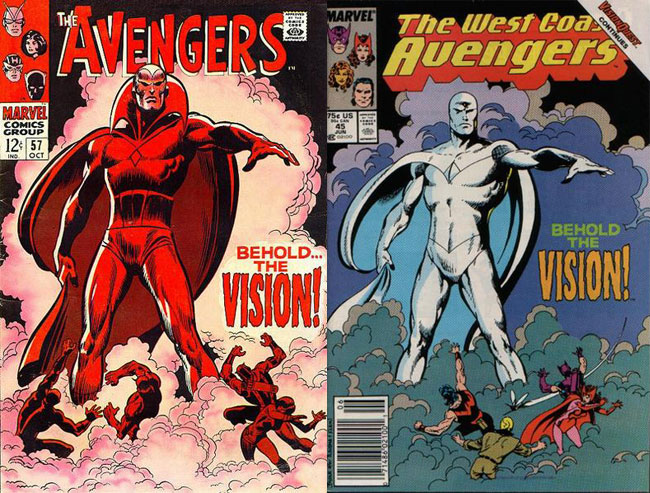
Separated at Birth: The ghost who walks

Avengers #57 and West Coast Avengers #45

L: Avengers #57 (October 1968), art by John Buscema (and George Klein?)
R: West Coast Avengers #45 (June 1989), art by John Byrne
(credited as "after Buscema and Klein")
(Click picture to Pym-size)


Wednesday, May 09, 2007

Going sailing and pillaging.

I'm off and away for a few days, sailing on the high seas of excitement and adventure, cruising the jeopardous waves of hazard.

Also, I'm off to Seattle. Read a good book about pirates while I'm gone, and I'll see you on Saturday with another "Separated at Birth." Be good to yourself and others!

Bully is reading about pirates today.


Tuesday, May 08, 2007

"I say, Bill Foster, old bean, do be frightfully careful of that Clor fellow, won't you?...Whoopsie-daisies!"

Yesterday I wrote about how P. G. Wodehouse's American publishers changed the original titles of several of his books when they published them in the US. Which got me to thinkin'...

What If™ a popular American comic book got retitled when it was published in the UK?

Why, I think it would go something like this:
A Slight Spot of Bother #1


Monday, May 07, 2007

Joy on the BBC

BBC JeevesIf you're interested in hearing those BBC full-cast radio dramatizations of the P. G. Wodehouse Jeeves and Bertie stories starring Michael Hordern and Richard Briers that I mentioned last week, you're in luck, Chuck: tune your wireless internet browser to BBC 7, where the Beeb's 24/7 radio station for drama, comedy, and quiz programmes is now running the serial of Joy in the Morning on each Monday for the next few weeks. They're currently on Episode Two, but Bertie gives a slap-dandy "the story so far" at the beginning of every ep. and you'll soon be up to speed. EDIT on 5/8/07: Actually, this week starts with the beginning and Episode One! (Sorry, I misread the BBC7 radio directory.) So you won't miss a second of Hordern's harrumphing as Jeeves if you start listening this week.

Complicated time-shifting and technical note: The BBC 7 "Listen Again" page I linked to above allows you to listen to any of their shows starting the day after they broadcast it, for a period of six days. Joy in the Morning runs on Mondays, so you can listen to the newest episode online starting Tuesday for six days. (Go to the page linked above and click on "Monday" to see the schedule and find the Wodehouse show.) If you don't see Monday at the top of the page, that's because it is Monday, so brew up a cuppa and relax until Tuesday comes about, and then you can listen to streaming audio of Monday's shows. Sic gloria tuesday, as I always say.

BBC7Root about in the "Listen Again" daily schedules and you'll likely find other programmes you may enjoy: dramatizations of Lord Peter Wimsey and Sherlock Holmes mysteries, classic British comedy like Hancock's Half Hour, Round the Horne, The Goon Show, The Navy Lark, Steptoe and Son and The Milligan Papers, funny quiz programmes like The News Quiz, Just a Minute and I'm Sorry, I Haven't a Clue, plenty of children's programming, and, on Saturdays, long blocks of classic shows introduced by famous British comedians. If you've never heard 'em, I recommend relatively recent radio comedies Dead Ringers and The Museum of Everything, and there's plenty more besides. The BBC! Your free portal to entertainment even if you don't pay the licencing fee!


A Wodehouse a Week #2: Pearls, Girls, and Monty Bodkin

A Wodehouse a Week banner
Last week I covered one of Wodehouse's earlier books, the 1923 The Inimitable Jeeves—but definitely not his earliest; he started publishing books in—gulp!:—1902. Now let's skip merrily towards the other end of his production to the charming and lyrical 1972 novel Pearls, Girls, and Monty Bodkin, Wodehouse's third-to-last finished novel before his death in 1975. But just 'coz it's a latter-day Wodehouse doesn't mean it's not prime: his brain and his trusty old typewriter were sharp and entertaining right to the end. (As a matter of fact, he outlasted his favorite brand of typewriter: when his trusty old Monarch gave up the ghost he reluctantly moved to a Royal for the rest of his output.) I'd even go so far as to say one of my favorite Wodehouse books is his final completed one, the Jeeves novel Aunts Aren't Gentlemen, published in the US under the title The Cat-Nappers. (Whoa, isn't that a wee bit confusing especially for fans and collectors? More on the dual-titles of Wodehouse's books a bit later.)

In fact, aside from a few hells, a spare damn or two, and a reference to Playboy magazine, there's very little that dates Pearls, Girls, and Monty Bodkin as a product of the post-Beatles age. Hapless heroes still fall in love and struggle to get permission to marry, cheerful heroines buck up their men with encouragement and a sisterly (for now) kiss, pudgy magnates still cower in fear from their shrewish wives and there's plenty of characters posing as valets in order to steal the titular pearls. And if there's any doubt whether the date of publication reads from the age of the flapper or the year of the miniskirt, consider this: 1972's (1973 in the US) Pearls, Girls, and Monty Bodkin is a sequel to The Luck of the Bodkins and takes place less than a year after that first novel...which was published in 1935. Golly! That makes waiting between J. D. Salinger novels a bit of a lark, doesn't it? To be fair, Wodehouse was producing a book a year for many of those intervening decades, but he revisits Monty Bodkin in media res and drops us right back into the thick of things with a brief and humorous resumé by the Greek Chorus of Wodehouse books: Chapter Two consists of a wonderfully witty synopsis of the events of the first book, as recounted in the smoking room of the Drones Club by the usual PGW clever trick of identifying characters by their drinks ("The Screwdriver moaned faintly and passed a piece of ice over his forehead. The Whisky Sour continued."). Within the space of a few swift pages you're immediately up to speed on Mister Bodkin's adventures and setbacks, whether you've never read the novel or read it forty years ago. (Remember this when I eventually review The Luck of the Bodkins: it involves a plush Mickey Mouse doll used to smuggle pearls through customs.) Wodehouse's clever and tight writing is wonderfully displayed in this "The Story So Far"-style chapter: it's definitely a recap but one with such light humor and whimsy that even if you've just finished reading the first book you don't mind it a bit. But then, as he might say himself (but with considerably more polished prose), it's off to the races as Young Monty is tipped immediately into his newest adventure.

A Wodehouse a Week #2: Pearls, Girls, and Monty BodkinThe beautiful thing about Pearls, Girls, and Monty Bodkin is not its originality or uniqueness, oh no no no. The plot is basically the same sort of formula Wodehouse used for many of his books, especially the non-Jeeves and non-Blandings love stories. Cheerful Monty is engaged to marry Gertrude Butterwick, but Gertrude's father won't allow her to marry such a gad-about town unless he proves he can hold down a job for one year. Mr. Butterwick disqualifies Monty's argument that he has already worked in Hollywood for twelve months under the tutelage of Superba-Llewellyn movie mogul Ivor Llewellyn on the basis that he (Monty) tricked him (Llewellyn) into hiring him in return for figuring out a way to smuggle his (Llewellyn's) wife's pearls in Mickey (Mouse's) plush interior...cf. The Luck of the Bodkins. Monty's relatively sure that if he fast-talks his way into another job for a year with Llewellyn all will be forgiven, but that, as they say in the movie business, is where the fun starts. Monty winds up at an English country estate (not a massive surprise there; most Wodehouse books zip along to country estates the way you and I zip along to the comic book shop) working as Llewellyn's secretary...at the same time Sandy, his pretty and spunky secretary from Hollywood, winds up working for Mrs. Grayce Llewellyn...at the same time a married pair of con artists are posing as guests of the house in order to steal the famous Llewellyn pearls...at the same time that a dishonest private investigator hired by Mr. Butterwick to keep an eye on Monty plots to steal the pearls himself. Add in a strict diet enforced by the fifth Mrs. Llewellyn and you have the entire cast of characters sneaking about after dark upstairs and downstairs in a manor house, poking about for pearls and raiding the fridge for creamy frothy desserts. But despite the early seventies period Wodehouse is writing in, don't even think that characters are wandering in and out of each other's bedrooms for romantic or sexual reasons...while the gears of his universe often turn on love, sex is invisible and like politics, never mentioned by the politest of people. (The only vague sign of the existence of sex in the Wodehouse world is the occasional baby popping up with a sticky rattle.)

Cream pies are stolen, jewels are hijacked, guns are brandished, and of course everything works out happily ever after. Monty discovers he'd much rather be in love with the admirable Sandy than the critical Gertrude, henpecked Ivor Llewellyn gets the last word and a good meal, and the criminals get their just desserts too...if not actual jail time, then the nasty pleasure of discovering the pearls they've stolen are cheap paste fakes. Once again harmony reigns over the World of Wodehouse, but the ride is as gleeful as the conclusion, especially with writing like this:
Monty could make nothing of this. Mr. Butterwick had left his hat with the hat-check girl, but had it been on his head he would have accused him on talking through it.

'I don't get your drift,' he said.

'I will make myself clearer,' responded Mr. Butterwick. A less austere man might have said 'I will continue snowing.' 'I have decided that you and my daughter must not see each other again.'

Barribault's Hotel is solidly built, and there is no record of the ceiling of its lobby ever having fallen on a customer's head. This, however, was what for an instant Monty was convinced had occurred, and he was amazed that the Maharajahs and Texan millionaires dotted about at their little tables were taking it so calmly.
or
'After that I had to go to Antoine's and he kept me for ever. Shampoo and a set and a tough-up. How do you like it?'

'It might be worse.'

'Good.'

'But I don't see how. Why on earth did you go to a plumber like Antoine?'

'I was told he was the best man in London.'

'I've nothing against his morals, but he can't do hair.'
or
'But Monty will stay on in England and I'll never see him again,' said Sandy, and the tears she had been trying to hold back burst their bonds. 'Don't pat my head,' she added.

'I will pat your head,' said Mr. Llewellyn stoutly. 'If I can't pay your head when it needs patting, whose head can I pat? My heart bleeds for you, pint size.'
Awwww. That last bit gets me right here in my little stuffed satin heart.

You of course all know the concept of six degrees of separation, right? Well, in a Wodehouse book, everyone had one degree of separation. Wodehouse casually mentions an old school chum of Monty's who has go on to be a policeman, and then several chapters later, Gertrude Butterwick tells her father that one of her new suitors is a policeman. Tuppence to you if you spot that they will be one and the same character. Sixpence if you realize that when Monty, Llewellyn, and Sandy are escaping from a dance club raided by the police, the copper placing his firm hand on Monty's arm and intoning the gist of the wot's all this then is the same fella as well. Everything and everyone is interconnected in a Wodehouse novel: the competing thieves are long-time rivals with a venomous history that only adds to the hilarity; characters pop up in juxtaposition to each other so frequently that in any other writer you'd be crying foul for overusing coincidence, but as always, Wodehouse does it with such a light and winking touch that it's forgivable. I considered getting out my pencil box and drawing a Venn diagram of the character's relations to each other, but they're all so connected, with every character having some sort of association to most every other, that it would soon look like a drawing of a tangled plate of spaghetti and I'd be running out of room on the edges of the paper to draw little arrows labeled "married to" or "sneaking food to" or "pulled a gun on." Even if I used the really, really big roll of drawing paper I'm allowed to take out on very special rainy days.

I read Pearls, Girls, and Monty Bodkin this week in an edition printed by Pennyfarthing Press, which I have to admit is a bit of a mystery publishing house to me. They are not related to this Penny-Farthing Press but were in fact a mass-market imprint of Dorset Press, itself a subsidiary of Marboro Books, an apparently defunct publishing house. I've got a handful of these Pennyfarthing Wodehouse reprints that I picked up at the Syracuse University Bookstore many many years ago...and have never seen them anywhere since. It's proof of the pudding that Wodehouse wrote so many books that even Penguin didn't publish them all. Collecting Wodehouse can be a complicated matter trying to track down various editions, especially when you consider that I have two editions of this book in my collection, and here's the second one:
A Wodehouse a Week #2: The Plot That Thickened


Have I pulled the wrong book off the shelf? Have I loaded the wrong photo onto Flickr? Did I miscode the IMG SRC tag (after all, it is a bit difficult with hooves!). No! This bright yellow hardcover with the mod seventies lettering is indeed titled The Plot That Thickened, but it is in fact the exact same book as Pearls, Girls, and Monty Bodkin...The Plot That Thickened is merely the name Simon and Schuster, the book's American publisher, gave it when it was published here in 1973. That's apt to be a bit confusing, isn't it? It's not for the reason you think: Wodehouse's British titles didn't need to be translated to American audiences, it's just a case of US publishers feeling they could come up with a more commercial title for their market. This case is far from the only time Wodehouse's American publishers renamed his books for US consumption, and very often with puzzling and oddball "why'd they do that?" results: the UK Summer Lightning became the US Fish Preferred, Galahad at Blandings became The Brinkmanship of Galahad Threepwood (thus piddling away a perfectly good tie-in to one of Wodehouse's most popular series), A Pelican at Blandings became the horribly-trying-to-be-hip No Nudes Is Good Nudes, and perhaps my least favorite of the American changes: the pitch-perfect sublime title Aunts Aren't Gentlemen was retitled The Cat-Nappers for the American audience. Pfui, I say, to these attempts to claim that they know better than Wodehouse, who spent a great deal of thought on his titles. (I thought this practice was pretty much over and done with, and then I remember Harry Potter and the Philosopher's/Sorcerer's Stone, and there's a book in the Fall Norton catalogue entitled American Jennie that is titled in the UK Jennie Churchill & Her Sisters.)

The best laugh, as always, is Wodehouse's: you can buy Pearls, Girls, and Monty Bodkin under that title in the US now in its Penguin edition. The laugh of the publishers, however, adds a hollow ring, because this fine later Wodehouse novel is criminally out of print in the US. There's plenty of used copies available through Amazon Marketplace in the link to the right, of course, or, if you're so inclined, order up a spankin' new copy from the good folk of the land of Wodehouse (that's England) at Amazon.co.uk. Sooner or later, of course, this book will be available in a hardcover reissue published by Overlook Press as part of their extensive Complete Wodehouse project, but if you can't wait, steal borrow a copy from your local library and prepare to chuckle.1973 novel by p g wodehouse featuring the character ivor llewellyn


Sunday, May 06, 2007

Saturday, May 05, 2007

Hey big spender

Free Comic Book Day


Don't forget: today is Free Comic Book Day!! Click on the logo below to learn more...
Free Comic Book Day


...and stop by your local comic book shop to pick up all assortment of fun free stuff! But do me a favor, okay? Actually, make that three favors:

1. Take a kid with you, okay? Take a son or a daughter, a niece or a nephew, a friend or a bully (tee hee!) with you and get some of the great all-ages comics available for them as well. (Hey, take a flip through 'em to make certain they're age appropriate, willya?)
2. While you're in the store, don't just grab free stuff and run. Buy some stuff as well, cheapskate! Help support the store so they can be around for FCBD '08. Buy some stuff for the kid too.
3. Head off, and take the kid, to see Spider-Man 3: The Spider-Mannining. Buy some nachos and ice cream too.

Have a great day! And enjoy your free comic books!


Separated at Birth: The problems of two cans of beans don't amount to a hill in this crazy world

Spirit Section 12/30/45 & Spirit #5

L: The Spirit Section (December 30, 1945), art by Will Eisner
R: The Spirit #5 (June 2007), art by Darwyn Cooke, J. Bone and Dave Stewart
(Click picture to Dolan-size)