Showing posts with label Penguin. Show all posts

Saturday, March 04, 2023

Today in Comics History, March 4, 3:42 AM: Penguin writes away for a manicure


from Batman: Killing Time #3 (DC, July 2022), script by Tom King, pencils and inks by David Marquez, colors by Alejandro Sánchez, letters by Clayton Cowles

Batman: Killing Time is a six-issue miniseries told in (very) non-consequtive order, but I've thrown my comic books on the floor and cut out all the panels and rearranged them in chronological order, just because that's the kind of thing I do (when I'm allowed to use adult scissors). Not every panel featured in posts on this comic book will contain the exact date or time — several have been labeled something like "Forty-two minutes before this, Batman pulled the Batmobile up to the speaker and ordered a Bat-Burger and Bat-Cola to go," and I've done my best to ID whichever day and time this is happening, so stay tuned for more!

This project is not helped by the sudden realization this morning that I don't own issue #2.

Saturday, December 31, 2022

Today in Comics History, December 31, New Year's Eve: Penguin has photos of Bono with the Queen


from Penguin: Pain & Prejudice #1 (DC, December 2011), script by Gregg Hurwitz, pencils and inks by Szymon Kudranski, color by John Kalisz, letters by Rob Leigh

Monday, July 04, 2022

Today in Comics History, July 4: Killer shark threatens holiday fun


from "The Killing Peck" in Secret Origins Special #1 (DC, October 1989), script by Alan Grant, pencils and inks by Sam Kieth, colors by Tom McCraw, letters by Albert DeGuzman

Tuesday, May 10, 2022

Today in Comics History, May 10: Happy birthday, Bono!

This is a much-expanded and -updated version of a post originally published October 06, 2011.

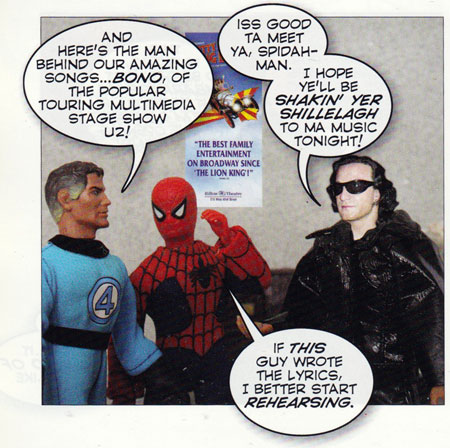
Born on this day: rock singer/songwriter, frontman of U2 (the band, not the submarine), and activist Bono (pictured here with Chico Marx).


from Justice (1986 series) #20 (Marvel/New Universe, June 1988), script by Peter David, pencils by Lee Weeks, inks by Mike Gustovich, colors by Janet Jackson, letters by Agustin Mas

Bono because famous in the Marvel Universe for being one of the archenemies of the She-Hulk!


from The Sensational She-Hulk (1989 series) #24 (Marvel, February 1991), script by Simon Furman, pencils by Bryan Hitch, inks by John Beatty, colors by Glynis Oliver, letters by Jim Novak

Bono and his band of lyrical leprechauns is available for all your party, christening, or bar mitzvah occasions!


from Penguin: Pain & Prejudice #1 (DC, December 2011), script by Gregg Hurwitz, pencils and inks by Szymon Kudranski, color by John Kalisz, letters by Rob Leigh

Well, we all know who Mr. One-Name is, right? Then your assignment...should you choose to accept it...describe in the comments who you think was in the photo with him and what they were doing. (Keep it clean and funny, folks!) Even better yet...Photoshop your own copy of the snapshot. (I can't stress that "keep it clean" bit too strongly here.)

Hotter-than-98.6 degrees Bully pal Aaron Fever provided us with this suggestion:


Me, I think I've figured out why a certain band from Athens, Georgia broke up:


Happy birthday, Bono, you nut, you crazy guy, you!


from "Web-Singers" in Toyfare #57 (Wizard, May 2002), by Pat McCallum, Tom Root, Zach Oat and Justin Aclin

Saturday, April 23, 2022

Comics Do Shakespeare: All's Well That Ends Well, Act 2: Penguin clearly didn't read the title of the play


from "The Killing Peck" in Secret Origins Special #1 one-shot (DC, October 1989), script by Alan Grant, pencils and inks by Sam Kieth, colors by Tom McCraw, letters by Albert DeGuzman

Comics Do Shakespeare: Julius Caesar: Act 2: How does this make you feel about little birdies now, kids?


from "The Killing Peck" in Secret Origins Special #1 one-shot (DC, October 1989), script by Alan Grant, pencils and inks by Sam Kieth, colors by Tom McCraw, letters by Albert DeGuzman

Comics Do Shakespeare: The Sonnets, Verse 2: Penguin right there, in black-and-white

Sonnet 94:

They that have power to hurt and will do none,
That do not do the thing they most do show,
Who, moving others, are themselves as stone,
Unmoved, cold, and to temptation slow:
They rightly do inherit heaven's graces
And husband nature's riches from expense;
They are the lords and owners of their faces,
Others but stewards of their excellence.
The summer's flower is to the summer sweet
Though to itself it only live and die,
But if that flower with base infection meet,
The basest weed outbraves his dignity:
     For sweetest things turn sourest by their deeds;
     Lilies that fester smell far worse than weeds.


from Batman #549 (DC, December 1997), script by Doug Moench, pencils by Kelley Jones, inks by John Beatty, colors by Gregory Wright, color separations by Android Images, letters by Todd Klein

Monday, August 18, 2014

Batman's Great Escapes Month, Day 18: Waddle I do when you are far away?


Panels from Batman #627 (Early July 2004), script by Judd Winick, pencils by Dustin Nguyen, inks by Richard Friend, colors by Alex Sinclair, letters by Clem Robins

Saturday, May 31, 2014

Today in Comics History, May 31: Penguin is nervous because the street has turned to oatmeal


from Batman: Legends of the Dark Knight #71 (DC, November 2013), script by Marc Guggenheim, pencils and inks by Federico Dallocchio, colors by Alejandro Sanchez, letters by Saida Temofonte

Monday, October 14, 2013

365 Days of DC House Ads, Day 287: Batman develops the metaphysical ability to turn pages of his own comic


House ad for Batman (1940 Series) #14 (December 1942); printed in Detective Comics #69 (November 1942)


Cover of Batman (1940 Series) #14 (December 1942), pencils and inks by Jerry Robinson

Sunday, December 30, 2012

366 Days with Alfred Pennyworth, Day 365


Page from Batman Adventures v.2 #10 (March 2004), script by Dan Slott, pencils by Rick Burchett, inks by Terry Beatty, colors by Zylonol, letters by Phil Balsman


Tuesday, May 15, 2012

366 Days with Alfred Pennyworth, Day 136


Panel from Batman #190 (March 1967), script by Gardner Fox, pencils by Sheldon Moldoff, inks by Joe Giella, letters by Gaspar Saladino


Tuesday, November 08, 2011

Election Day: Demarche of The Penguin*

Happy Election Day, everyone! I hope you'll all have time to read this so you can get back to the couch and be sure not to miss the annual viewing of You're Not Elected, Charlie Brown and Rudolph's Hanging Chad Adventure followed by the all-new Faith Hill Family Election Night Musical Special! Boy, I can not wait until that spinny thing comes out and says it's a CBS special presentation!


Say, trivia buffs...do you know what long-running CBS TV program that "CBS Special Presentation" music is taken from? (No, no, it's not Kate and Ally.) It's actually from the Hawaii 5-O soundtrack. Look for the puece titled "Call to Danger" and you'll hear it towards the end of that track!

But back to election day. As Batman reminded you yesterday, the American political structure is based on the common citizen's ability to see past the glitz and glamor of contemporary politics to examine the real issues at hand. Like pollution. Urban crime. And all those parking tickets the Batmobile gets when Batman and Robin leave it in front of Gotham City's police headquarters.

That still and speech were taken from a Batman '66 episode, "Hizzoner the Penguin," in which that foul fowl featured fiend, Oswald Cobblepot, The Penguin, ran for (and almost won) mayorship of Gotham City, USA! Holy rigged elections, Batman! So inspiring was this concept that Tim Burton later made it a plotline in his blockbuster 1992 motion picture Batman Returns, a movie especially noticed for its creation of a Catwoman who can come back from the dead and still can't hide seams in her costume and the line "You know, mistletoe can be deadly if you eat it. " Good advice by Batman, folks! But it's not until the comic book series Batman Adventures (2003 series) that the idea becomes a reality: Penguin really does get elected to become Gotham's Mayor! Aieeee! That's pretty dire! I mean, I can't think of a single worse person to become mayor...


cover of Batman: Dark Detective #1 (DC, July 2005), pencils by Marshall Rogers, inks by Terry Austin, logo design by Todd Klein

Hmmm, okay. Point taken.


Saturday, July 16, 2011

Same Story, Different Cover: Sometimes I'm glad we don't live in New Zealand anymore. All those penguins...


L: Detective Comics #473 (November 1977), cover art by Marshall Rogers
R: Shadow of the Batman #3 (February 1986), reprinting Detective #473, cover art by Marshall Rogers

(Click picture to emperor penguin-size)


Tuesday, May 13, 2008

For Your Eyes Only: Recent Book Cover Designs of the James Bond Novels

Okay, everybody, sing along with me: Who's the Brit secret agent who's a love machine to all the birds? Bond! That bloke Bond is one bloody mothershag... Kindly please be quiet! But I'm just talking about Bond!

Ian FlemingMay 28th of this year (mark your calendars now!) is the 100th birthday of Ian Fleming, creator and writer of James Bond, British secret service agent. (He also created Chitty-Chitty-Bang-Bang, but that's a whole 'nother post.) Whether you're a fan of or scoff at the sometimes brutal, occasionally elegant prose of Fleming, you can't deny his, and his creation's, impact upon world pop culture. And while the original novels and short stories that introduced Bond to a world desperately in need of a Cold Warrior are perhaps not quite suitable for a little stuffed bull's nighttime reading, they're still among my favorites—I think that From Russia With Love is one of the finer spy novels of the genre. Fleming has inspired hundreds of imitators, not merely in the movie field (everyone from Matt Helm to Austin Powers, Derek Flint to Bart Fargo owes a debt to Ian Fleming. And so do you!

Because a world with James Bond is a world of justice, pop culture isn't letting the Fleming centenary pass without hoisting its martinis. There's a new Daniel Craig 007 movie out this fall, of course, London's Imperial War Museum is hosting a year-long exhibition saluting Bond and Fleming, and and a brand-new Bond novel by Sebastian Faulks will be published on May 28th, not to mention a new "Young Bond" YA novel by Charlie Higson this fall. There's also a London museum show of the design and imagery of the James Bond book jackets. Wait a minute. Book jackets? How exciting could that be, you scoff?

As far as little stuffed me is concerned, pretty darn exciting. While the rest of the world is worrying about whether or not Amy Winehouse is gonna do the theme song for the new Bond film (A: nope), I'm more interested in seeing what the tie-in books will look like. I don't collect Flemings the way I do Wodehouse, but I have several copies of many of the Bond books, and part of the fun is the gorgeous and iconic cover design on the many editions from the 1960s through today. In addition to the exhibit show at the Fleming Collection, the UK's Royal Mail issued this year sets of James Bond book cover stamps, showing the evolution of the 007 classics. Collect 'em all!:

James Bond Book Cover Stamps


The early Fleming book covers ranged from subtle to lurid, from literary to pulp fiction (the latter especially on the iconic Pan UK paperback series, several shown below with the yellow rounded title box at the top of the front cover):

Classic James Bond covers


Many of the Pan covers were painted by the illustrious art team of Sam "Peff" Peffer and Pat Owen—they worked on more than 400 Pan covers, as this excellent interview from the definitive Pan Paperback Collector's Website shows.

Ah, they don't make 'em like they used to, you sigh, gazing over the classic iconography of Bonds-gone-by. As Sean Connery himself might tell you: "That'sh not very bloody accurate." In recent years the good design folks at Penguin Books have turned out several series of eye-catching and vibrant book jackets for the Bond series, reflecting in their work the reverence and love collectors and readers have for the character and series. I'm very fond of this recent Penguin Modern Classics design, which re-invented the book design as high literature alongside other Penguin Classics: using a gunmetal-grey modern horizontal bar, an modernization of Germano Facetti's 1960s Penguin Modern Classics design. It's accompanied by photography—in some cases using stills from the motion pictures:

James Bond Penguin Modern Classics


Sadly, these covers are out of print now, replaced by a more "commercial" approach using the same photography but large lettering and more symbolic imagery:

James Bond Penguin Modern Classics 2


The Penguin Modern Classics redesign isn't my favorite, sacrificing the classic Penguin look for more newsstand-friendly larger typography. But if this book cover series seemed to be a step backwards in my book (no pun intended), then the next set of Penguin Bonds was a bold leap forward by utilizing iconography and design of the past. This series referenced the old pulp covers in colorful, brilliant painted covers, each like a mini-movie poster for the book, uniform in design but each featuring their own typography and visual elements appropriate to the plot, as well as those famous Bond Girls:

Penguin James Bond redesigns


Quantum of SolaceI've treated myself to the entire set o' these, and gorgeous they look on my bookcase. If you like 'em, you're in luck: these are the current editions now on sale in bookstores, and you can, as they say, collect 'em all. Each of the Fleming Bonds is available in this gorgeous redesign, with another volume coming this fall: Quantum of Solace, collecting all the 007 short stories in one volume. Those short stories are already in the individual books like For Your Eyes Only and Octopussy, so this volume isn't a must-have unless you simply must have it for the cover art. Which, judging by the Bond Girl on the cover, suggests to us that maybe Scarlett Johansson is starring in the new 007 movie. If so, good show! Scarlett Johansson: Always a Very Good Thing.

But wait? Are those The Best Bond Covers Ever? Well, until recently I woulda said yes sir, but the forthcoming Penguin uniform hardcover edition (being release May 28th in the UK, no scheduled date yet in the US) is about to give 'em a run for their money. The entire Fleming series of James Bond novels has been redesigned with new cover paintings by Michael Gillette: bold colorful graphics of the great Bond Girls from Honey Ryder to Gala Brand, from Vesper Lynd to Tracy di Vincezo, from Vivienne Michel to...um...to Miss Pussy Galore: Check out some of them, but keep your eyes in their sockets, please:

New Penguin James Bond covers


Wow. I love these designs, and to paraphrase Ash Ketchum, "gotta get 'em all." Even the penguin in the Penguin Books logo is getting in on the 100th anniversary celebration act:

Penguin logo


You can see the entire series and read more about the Fleming cover redesigns at the Penguin UK website...be sure to click on the small cover thumbprints to get the really huge blow-ups of each and every cover.

Everybody has their favorite Bond actors and movies—but if you've never read an Ian Fleming novel, you owe it to yourself to pick one up and see how Britain's super-spy started out. You might be surprised: Bond's a rougher, crueler, more ruthless and misanthropic character in the books than the movies, minus most of the gadgets and wisecracks but with plenty of action, thrills, and that trademark writing trick known as "The Fleming Sweep," in which Ian tells us about Bond's likes and dislikes in travel, clothing, food and wine, giving us an entertaining brand-name review of the products he's using. Whichever book you choose, you'll find Fleming's characteristic touches. My favorites are Casino Royale (the recent movie was in many ways remarkably faithful to the book, more so than any Bond movie since the late 1960s), From Russia with Love (a solid novel that works as a spy thriller even if it didn't star Bond), and the very atypical The Spy Who Loved me (in which Bond is merely a supporting character to the life story of a young girl). The weakest of the book is The Man with the Golden Gun, so I wouldn't recommend it for your first Bond novel. But if you go for one of the recent Penguin Books editions, you can pretty much know that although you shouldn't judge a book by its cover, those covers are pretty amazing too.


Monday, April 30, 2007

A Wodehouse a Week #1: The Inimitable Jeeves

"It is my practice, on retiring, to read a few pages of some instructive book."—Jeeves, in The Inimitable Jeeves
A Wodehouse a Week banner


Here's something new I've been wanting to do for a long time. This isn't comics (although it is comic), but, as Homer Simpson says, "Let's see where this goes.": I'm going to read and review every P. G. Wodehouse book, once a week, over the next couple years or so. (Don't forget to mock my ambition thoroughly around week six when I start forgetting or ignoring it!)

Wodehouse collectionTwo years, you say? Well, yeah, kinda. Wodehouse wrote around 93 books—that's not including the collections or anthologies made up of his stories or published posthumously in themed collections. As you can see from my PGW bookcase in the photo to the left, I've got most (not all) of them. Why do I love him so much to collect all these many books in various editions? Now, this is jus' a little stuffed bull's opinion, but I believe that Wodehouse was almost certainly the top humorists of all time—and not just in English, but around the world. I've said on occasion and I'll say it again that he's the finest writer of English light prose in the twentieth century. That might be a little bit of hyperbole but please excuse me when I state that, because I feel that no one can turn a phrase quite like Wodehouse; no one can bring such joy and light to a swiftly-turning page, and—and for me, this is a very important one—no one captures the lyricism of the English music hall in prose form like him. In fact, Wodehouse wrote the book and lyrics for many popular musical comedies and contributed to dozens of others including Show Boat and Anything Goes.

But it's in his books (mostly fiction, a handful of non-fiction memoirs and essays) that Wodehouse really shines. Even to kick off this supposedly weekly series, I'm not going to offer a massive biography of the man (isn't that what Wikipedia is for?), although I'll fill in a few blanks here and there along the way. No, this is strictly to capture the joy and the heart of his stories and characters, one week at a time. I will tell you a little about my Wodehouse collection and my experience with the various books as I go along—some personal Bully anecdotes about hunting down old ragged editions of my favorite novels and collections even though I might have a different version at home in the tall bookcase. Unlike my comics reviews there's no need to grade these week after week, because I have never read a P. G. Wodehouse book I have not thought was immense fun.

Reading The Inimitable JeevesFirst up: The Inimitable Jeeves, originally published in 1923, is a series of short stories by Wodehouse collected from their magazine publication (most of them first appeared in The Strand magazine), featuring Wodehouse's most famous creation: the ultimate gentleman's gentleman, Jeeves. Wodehouse wrote two main series of books, the Jeeves and Bertie Wooster adventures and the Blandings Castle sagas, plus dozens and dozens of other novels and short stories, most of them romantic comedies feature a hapless hero's love for his lady fair...or maybe for golf. If we want to apply comic book terminology to Wodehouse's work, when you read carefully you can see it all exists in one single universe (call it "Earth-PGW"). Characters cross over from one story to the next: a character in a Blandings novel may belong to the Drones Club, Bertie Wooster's haven; a background character in a romance might have a major role in a golf story, and many, many members of the Mulliner family cross over between stories and sagas with the ease of The Flash zooming over to Earth-2. In short, although he probably didn't intend it from the beginning in these early stories, Wodehouse was setting the stage for his vast and gleefully complicated world in The Inimitable Jeeves.

The Inimitable Jeeves consists of 18 chapters—it's not quite a novel and it's not quite short stories. "Whoa, there, Bully!" you declare, "Explain that!" And of course I shall! Modern day publishers might try to spin this as "a novel in stories," but I doubt Wodehouse was quite so modern-thinking. The origins of these stories as originally published in magazines, but even though they were published separately, one leads into the next with swift grace, a gradual increase in hilarity and an eventual pay-off of a marriage (not for our heroes!) in the final story. In my editions of this book, one printed in 1954 and one in 1980, most of the stories consist of a single short story spread out among two different chapters, which leads to the "novel" effect. (Later editions of The Inimitable Jeeves combines every two-part story into one section, rather arrogantly ignoring the careful pace Wodehouse set up to build to a tense upswing at the beginning of part one and a complicated but happy conclusion at the end of part two.) As such, you can dip into this book like a bowl of peanuts—flip open and sample one chapter for flavor, and then skip about: there's a building sense of continuity but it's less important than the internal structure of the stories themselves. To prove this point, at least one of these stories ("The Great Sermon Handicap") is often anthologized by itself and rightfully so; it's one of the finest comic short stories ever and a jewel in Wodehouse's already sparkling crown. But when you do read The Inimitable Jeeves from start to finish you begin to understand why even early Wodehouse is so compelling. Plots zip in and intertwine and build on one another from story to story. The first story introduces yet another love of Bingo Little, Bertie Wooster's close friend, and throughout the book we're introduced to a bewilderingly swift series of Bingo's love interests, each of which he intends to marry. It's only at the end in the pay-off to an earlier plot line comes around full circle. Bingo winds up marrying a romance novelist whom Bertie was earlier impersonating under a pen name in order to get Bingo's uncle to support the marriage financially. (Trust me, it makes more sense and for much more hilarity in the book itself.) Wodehouse has an impeccable sense of timing and rhythm and as subplots spiral in and out of Jeeves and Bertie's life it's like one wild music-hall juggling act, but by the end Wodehouse catches every ball.

And his writing! If you want to laugh out loud, well, dear reader, pick up a Wodehouse. I will probably wind up gushing far too much and quoting far too many excerpts through the months of the "Wodehouse a Week" project. It's true that comedy is often less funny taken out of context. But turns of phrases that might come out clunky and leaden from other writers positively soar from the typewriter of Wodehouse. He took great care in rewriting and revising his books (his final novel is reprinted in progress in Sunset at Blandings and gives an amazing look at how closely he worked in revisions and editing his original first versions, polishing plots and dialogue until they were pitch perfect.) Seriously, how can you not love Bertie Wooster when he opines about a reluctant breakfast:
A roll and butter and a small coffee seemed to be the only things on the list that hadn't been specially prepared by the nastier-minded members of the Borgia family for people they had a particular grudge against, so I chose them.
or, upon meeting Bingo's pudgy uncle:
The motto of the Little family was evidently 'variety.' Young Bingo is long and thin and hasn't had a superfluous ounce on him since we first met; but his uncle restored the average and a bit over. The hand which grasped mine wrapped it round and enfolded it till I began to wonder if I'd ever get it out without excavating machinery.
This is one of the first Jeeves and Bertie books, and I believe it may have been the first Wodehouse I ever read, which is why I chose it to kick off this series of posts (Future books may be chosen at similar purpose, or at random, or even just capricious whim). It's an ideal "starter" Wodehouse not merely because it features his two greatest characters in early, accessible stories, but because from page one he tells you everything you need to know about Bertie and Jeeves' relationship in a few short paras. Not merely everything you need to know for this book, but—as it would turn out, basically everything you need to know about their relationship for reading every future Bertie and Jeeves book:
'How's the weather, Jeeves?'

'Exceptionally clement, sir.'

'Anything in the papers?'

'Some slight friction threatening in the Balkans, sir. Otherwise, nothing.'

'I say, Jeeves, a man I met at the club last night told me to put my shirt on Privateer for the two o'clock race this afternoon. How about it?'

'I should not advocate it, sir. The stable is not sanguine.'

That was enough for me. Jeeves knows. How, I couldn't say, but he knows. There was a time when I would laugh lightly, and go ahead, and lose my little all against his advice, but not now.

'Talking of shirts,' I said, 'have those mauve ones I ordered arrived yet?'

'Yes sir. I sent them back.'

'Sent them back?'

'Yes, sir. They would not have become you.'

Well, I must say I'd thought fairly highly of those shirtings, but I bowed to superior knowledge. Weak? I don't know. Most fellows, no doubt, are all for having their valets confine their activities to creasing trousers and what not without trying to run the home; but it's different with Jeeves. right from the first day he came to me, I have looked upon him as a sort of guide, philosopher, and friend.
There you have it: Jeeves 101 in a dozen or so dialogue lines. Most everything you need to know to reach 1923's The Inimitable Jeeves. And, as it turns out, most everything you need to know to read every single Jeeves story from then until the final ones in the late 1970s: Jeeves is whip-smart, has impeccable taste, and intentions that his master display that taste as well. Many Bertie Wooster tales—including no fewer than three in this book—hinge on Jeeves withholding the solution to a particularly tangled mess of affairs until Bertie gets rid of a pair of outrageous purple socks, or colored spats, or a garish necktie. Boring? No. Consistent. Critics of Wodehouse declare he wrote the same story ninety-three times. I say, all the better for it. It's a very familiar and friendly world each book dips us into, like having a cup of tea every day. And to pointedly argue back, Wodehouse's structure and flow of action is generally repeated from novel to novel, but not his plots. Like a good Columbo episode, it's not finding out whodunit in the end: it's the joyride along the way.

Penguin edition of The Inimitable JeevesThis 1923 collection of Jeeves stories doesn't yet include one of Wodehouse's greatest creations, Bertie's boisterous Aunt Dahlia (the early Bertie stories usually faced him off against his Aunt Agatha, often described as eating broken glass for breakfast). It's got an unfortunate Stepin Fetchit moment when Bertie converses with a black lift operator (or, as Bertie refers to him, "the coloured chappie"), who speaks in a dialogue pattern that would even make Will Eisner's Ebony cringe. Some segments of stories drag slightly and the dénouement of others seem slightly rushed or repetitive (less a crime in their original magazine publication). But it's still vintage Wodehouse, and I'll forgive any minor clunkiness because, as mentioned above, it features one of the finest and funniest short comic stories in English, "The Great Sermon Handicap," in which Bertie and associates scheme to make a betting book on the Sunday sermon length of several rural hamlet's church pastors. Like the best Wodehouse stories, there's twists and turns and it spirals in on itself, and it all works out best for everyone in the end, even though they're all poorer in the pocket—except, of course, for Jeeves.

It all works out well in the end. That's the catchphrase for any Wodehouse story. He did not write on matters of seriousness or gloom, and no book ends on a down or sad note. One week ago today I was writing of Shakespearean tragedy and how you could point to a modern equivalent of it in a Doctor Doom comic book story. Well, every novel of Wodehouse's is a prime example of Shakespearean comedy, almost always quite literally as Shakespeare intended by ending with a wedding for the protagonist. (Or at least our hero and our heroine, arm in arm, swooning together). Bertie Wooster is the exception. Others may get married around him (Bingo takes the plunge, finally and deeply, at the end of this book), but thanks to the clever machinations of Jeeves, he remains in his happy single bachelorhood through every single story, despite being engaged more often than Elizabeth Taylor. It helps to maintain the timelessness of these stories that the basic universe is reset at the end of every book: Bertie and Jeeves together. The final chapter of The Inimitable Jeeves is titled "All's Well," in the grandest Shakespearean tradition. And it would remain well through every single Bertie and Jeeves story and novel from beginning to end, most of them finishing with Jeeves getting the last approving word of "Very good, sir."

Picturing Wodehouse: A brief aside on the cover of my 1980 edition, published by Penguin Books. For many, many years Wodehouse books in their familiar orange Penguin editions were published with cover illustrations by former Punch cartoonist Ionicus (Joshua Armitage). There have been many, many other illustrators of Wodehouse books both before and after Ionicus, but his work holds a special place in my little red satin heart as my first visual introduction to Wodehouse's world, especially Jeeves in his striped trousers. For a publisher, it can be risky to try and portray a beloved fictional character. Geoff Hunt, for example, has never painted Jack Aubrey—except maybe in tiny, tiny pinprick scale—on any of the covers of the Patrick O'Brian books. Many of us take our internal vision of Jack Aubrey as being that of Russell Crowe in the movie version of Master and Commander. (O'Brian purists will argue that you really shouldn't.) Likewise, you may very well have in your head a vision of Jeeves as Stephen Fry and Bertie as Hugh Laurie from the popular and very faithful Jeeves and Wooster BBC-TV series. I liked those a lot, but my favorite dramatic Jeeves and Bertie are merely voices: Michael Hordern and Richard Briers played Jeeves and Bertie on a series of BBC radio comedies in the 1980s and 1990. (You can order the tapes featuring the dramatizations of these stories using the Amazon link to the right.) Both actors have pitch-perfect voices and still allow me to picture the characters as designed by Ionicus, as in the cover of my copy of The Inimitable Jeeves:
The Inimitable Jeeves


This scene is from a story in which Bertie hosts a luncheon for Bingo's new circle of friends, a fervent club of Bolshevists (as usual, Bingo's only interested in the Communist movement because he's in love with the girl in blue at the far end of the table, the aptly named Charlotte Corday Rowbotham). There's Jeeves, of course, but I'm not entirely certain Bertie is in this cover at all: the only possible figure he might be is the monocled gentleman in the back. Ionicus often drew Bertie with a monocle, but usually with much darker hair and looking less severe and rather more...well, gormless, to put it kindly. But Bertie offstage or no, the characters, expressions, and poses are pitch perfect, even if Bingo Little comes off a wee bit like Jimmy Carter, Junior:
The Inimitable Jeeves


At the end of each of these reviews (many of which will be much, much, shorter than this one), I'll give you the usual Amazon link—ah, there it is right over on the side!—to pick up that book in case your interest is piqued and like Jeeves, you desire an instructive book before bedtime. But to be fair, many libraries carry a good selection of Wodehouse books, and while it'd be fun to have some of you read the one I'm discussing and add your own comments, really—pick a Wodehouse, pick any Wodehouse. They're all joyous and delightful. You may not want to read one every week for two years, but you'll want to read more. When all around you is grey and rainy and sad, I can think of no better pick-me-up than curling in a big soft armchair with a piled of buttered toast, a cup of hot tea, some Eric Coates on the wireless, and burying your nose in a book by P. G. Wodehouse.

Wednesday, April 18, 2007

Orange you glad you can read a Penguin?

Piqued by Penguins proceeding from my previous post? Here's some Penguins in my collection, books which bring not only delight and entertainment to a bullish reader but also brilliant and bright flashes of orange to any self-respective bookshelf. In other word, these are a few of my favorite Penguins:


I've said before, I'll say again: I believe P. G. Wodehouse is the finest writer in English literature of the twentieth century. Even if you scoff and scold at my admittedly bull-headed opinion, you can't deny that his books are among the most fun! They're fun to add to my large Wodehouse collection, too, especially since so many of them are in Penguin editions!


One of the prides of my Wodehouse collection is this Penguin paperback reprint of The Inimitable Jeeves: a title that was among one of the first Wodehouses I ever read and bought. I still have that edition with its faded orange spine and delightful Ionicus cover illustration, but when I saw this older Penguin in the classic all-typography format in a used bookstore (now sadly closed) in Gloucester Road in London, I just had to have it. The Inimitable Jeeves is top of the top: it features one of the finest comics stories of literature, "The Great Sermon Handicap."

Graham Greene has learned the first lesson in not being seen: not to stand up.
More London bookshopping, but slightly more recent: I survey a tray of assorted used Penguins of differing vintage at the Waterloo Bridge Book Fair on the South Bank of the Thames. Irony alert: the whole purpose of me going to this open air book stall was to look for Penguin editions of Graham Greene, and I didn't find one. Until I later examined my photo more carefully...and realized there had been one right at my hooftips, in the lower right hand corner. If it'd been a real Penguin it'a bit me.

Tiny Penguins just my size
For the sixtieth anniversary of the firm, Penguin issued "The Penguin 60s": a large collection of slim, tiny paperbacks featuring a short story or two or a brief excerpt from a book to commemorate and celebrate their long history and range of authors and titles. These all cost 60 pence (99 cents in the US) which, to a bull who is very careful with his dimes, was very good value for money. I didn't collect the whole set (I never did get the Grant Naylor Red Dwarf one!), and several other series in this format were published over the following few years. The perfect stocking stuffer or gift for your friends who have short attention spans.

Oroboros.
Penguins about Penguins are the best Penguins at all! I've already written in-depth in my last post about the delightful Penguin Special, but I also recommend Penguin by Design, a colorful picture history of Penguin's unparalleled book designs and groundbreaking advances in typography: a beautiful and informative book. We as comic book fans swear allegiance to DC or Make Mine Marvel, but in the world of trade books, it's seldom that you can express a love and admiration for a publishing company rather than simply its authors. Penguin is one of those grand firms that always made me want to work in publishing. Thank you, Allen Lane, for being an inspiration to this little stuffed bull!


Tuesday, April 17, 2007

Bully's Book Club: Penguin Special: The Life and Times of Allen Lane

Bully's Book Club


For somebody like me who loves books, there is nothing quite as delight-on-delight satisfying as a book about books: the Double-Stuf Oreo of publishing. I was chuffed as a chicken to come home from my Christmas London holiday with Penguin Special: The Life and Times of Allen Lane by Jeremy Lewis under my arm:—a big, detailed but brisk history of Penguin Books (and its founder Allen Lane): those little orange pocket paperbacks that changed the history of publishing forever when they were introduced in England in 1935. Like the BBC and the London Underground, Penguins are a quintessentially English innovation that as much defined the society of pre- and especially post-War Britain as they did the book trade.

It's not big secret to regular Bully-readers that when I'm not readin' comics or playin' hopscotch or doin' jigsaw puzzles or pettin' my kittycat, I run up and down the halls at a Certain Biggish New York Publishing Company and do my best to sell our books to the outside world so you can all read 'em. Suspend the conventional wisdom that I am six-and-a-half years old when I tell you I've been working in the publishing world for more years than you've had hot dinners (this month, at least), and after a while in the trenches of being a book rep on the road and in the busy busy offices you sometimes feel like you know most everything there is about the world of publishing. Well, think again, Buster! Or should I say, Bully, because not only was this the most entertaining book I brought home from my London sojourn, it's also the most educational. I learned more about my chosen career in the several days of "can't put it down" devouring of Penguin Special than I have in...well, let's not say how many years.

Publishing in pre-War Britain was a lot different. In those days, publishing was (as it still is, sorta) big business, but with books having a lot less competition for entertainment attention and a good deal more prestige in society: the goings-on of literary gurus and big-name publishers were regular fodder for the daily newspapers. Aside from Judith Regan, has that happened much in modern times? (A: It has not.) But it was a world in which books were more luxuries than necessities: priced at shillings rather than pence. Paperbacks existed, but poorly designed and printed, pricey, and—hampered by publishers fearing lost sales of their more expensive hardcover editions—they featured subjects often more scholarly than popular. Allen Lane (born into a publishing company family that ran the prestigious legacy firm The Bodley Head) didn't create the paperback, but he made it a product of his time: he came up with the concept of the accesible and affordable sixpenny paperback, a book line that could appeal to all classes and economic backgrounds without sacrificing design standards, legibility, or entertainment potential. Sounds like a sure thing, right?

Easier said than done. Derided by naysayers and rival publishers, the immense risk Lane took in introduce a line of exceptionally inexpensive pocket-sized paperbacks might have been a massive bust, but instead created a boom in the industry that (eventually) all publishers would race to copy. Jeffrey Lewis has some wonderful anecdotes of how the venture nearly failed before being saved by Woolworth's shops, who ordered enough of the first batch of Penguins to save the firm—and who sold enough to make them the smash hit they became.

The most amazing thing about this orange-spined success story is how it likely could not have happened in any other stretch of history: Penguin Books were a "perfect storm" that caught the zeitgeist and capitalized on the twentieth century's massive sweeping changes in culture and society: a growing middle class following The Great War, the movement towards inexpensive and value-for-money entertainment during the lean years of the Blitz, the need to disseminate political and social warnings about Hitler and socialism to a large populace, the slow but distinct dissolve of the barriers between the upper, middle, and lower classes during the Second World War where different social levels huddled in air raid shelters or went off to the front lines together, the post-War period quest for self-improvement and a thirst for knowledge to bring about the Golden Albion promised by politicians: all of these were perfect fuel for a paperback novel or non-fiction book; all of these contributed to the expansion of Penguin into art, childrens', history, philosophy and world literature lines that still are regarded with awe and respect even in this age of mass publishing.

It's also a tale of a Golden Age past and done with: with little competition for entertainment to the masses aside from the all-popular wireless BBC programmes, reading commanded a larger percentage of consumer attention and spending than it does today. Lewis describes one of Lane's ultra-successful publishing events called "The Millions": Penguin reissued ten classic works by major authors at a time, in print runs of 100,000 each. Shaw, Waugh, D. H. Lawrence, Agatha Christie and Georges Simenon, among others, all got their own "Millions" promotion. Let me repeat that reprint figure, okay: One. Hundred. Thousand. Each. Keep in mind these were not ten new books but reprints of long-available Penguin paperbacks. Nowadays most reissues of paperbacks can have difficulty topping 5,000 in a print run, and you seldom want to risk overwhelming booksellers or consumers by bringing out more than a handful or reissues by one author at a time, so was Lane's plan successful? Bloody yes:
[Lane's] pleasure was still greater when, on the day of publication, the manager of W. H. Smith's in Baker Street rang to say that a seemingly interminable queue building up outside his shop did not consist of stranded commuters but eager buyers of Bernard Shaw. The Million sold out in six weeks.
Good gravy. That was a different, different world indeed.

There's wonderful characters from British modern history and the book world in here: Bernard Shaw and Agatha Christie were especial close friends of the firm and of Allen Lane, as well as delicious literary gossip that makes for fun "ah ha" moments: upset with what he felt was pedestrian treatment from his publisher The Bodley Head, Oscar Wilde named a dull butler character in The Importance of Being Earnest after Allen Lane's uncle John Lane. The details are incisive and the history is in-depth, all based on personal and company papers opened specially for this book, as well as interviews with remaining surviving early Penguin personnel. There's some wonderful sweeping bits in here about the looming presence of the American publishing juggernaut that would eventually threaten Penguin and change their long-running typography-only covers into paperbacks with artwork on the cover (loathed by Lane; he called American firm Pocket Books "Porno Books" for their lurid covers).

It's educational, too. Whether or not you're in the business of publishing, you'll learn a heck of a lot about the trade and how it works—or more accurately, worked, though Lane's hard-earned and strictly-adhered-to lessons in the book trade are still of value to publishers today (who sometimes ignore history at their own peril):
[Lane] went on to say that word of mouth was the most effective way to make a bestseller, and that books should only be advertised if they were being talked about...Lane would always regard expensive publicity as a waste of good money.
Jeremy Lewis writes with a wonderful tongue-in-cheek style, breezy and fast-paced, often with tart dry humor tucked in the middle of a seemingly-innocuous sentence:
An ex-marine, [Lane's butler] Knight lived in nearby Praed Street: he made tea in the morning, ran the all-important bath, cooked breakfast and an evening meal specializing in steak and kidney pies, did the housework and claimed, misleadingly, to be teetotal.
or
Adprint favored a firm in the Sudetenland, hardly the most suitable venue in 1938.
or
[A] party was held in the garden behind Pevsner's office in Gower Street in July 1949 to celebrate the fiftieth King Penguin: some penguins were brought in from the Zoo, one of which lost control and savaged a guest.
Do I recommend Penguin Special? Heck yeah, with bells on. Two hooves up. It's the most entertaining book I've read this year (and I read a bucketload) and it's likely to stay with me as a wonderful and colorful portrait of the publishing world. (You can buy it from Amazon.com using the link on the right, or order it direct from England using Amazon.co.uk: the UK edition'll run you about thirteen buckets plus five to seven dollars shipping, but you may get it a little faster than waiting for Amazon.com to find or import a copy for you.) If you're not working in the book world you'll enjoy it as a business success story, solid British history filled with colorful characters...but if you spend your days writing, or selling books, or publishing 'em...well, this book is about as close as you'll get to somebody throwing a party for your way of life and helping you to see it in a new light and appreciation for its history. After many years of being a publishers' sales rep, I was especially taken by this delightful portrait of an early working Allen Lane:
He enjoyed the cameraderie of the trade, the drinks and the gossip; like all the best publishers, he had a good memory for books published by rival firms as well as by The Bodley Head, and, without necessarily reading more than a page or two, had a shrewd sense of what books would, or would not, suit particular shops and buyers. His convivality, his readiness to combine business with pleasure, and his dashing good looks made him a popular figure in the trade; he thought most bookshops dreary and offputting, but his understanding of and liking for booksellers themselves—not always shared by the grander or more literary type of publisher, uneasy in the company of tradesmen—was to serve him well in the years ahead....Thirty years on, writing to thank an old colleague who had written to congratulate him on his knighthood, Lane looked back with a certain nostalgia. 'It is a far cry', he wrote, 'from the days when you and I traipsed the city streets trying to sell a few books, but I not sure that wasn't the about the happiest period of my life.'
When I am an old and grey and shaggy bull who's put in my full time at the firm and I'm ready to retire to my green fields, I can only wish for such an epitaph: he loved books. He loved publishing books. He loved selling books. And in the end, who wouldn't?