Thursday, January 09, 2014

365 Days of KirbyTech, Day 9: The Growth Machine

Speaking as we were the other day of vaguely Transylvanian, sorta-Frankensteinian doings, here's a guy who openly mocks not only science and humanity but also the basic tents of storytelling. Because if you build anything in Doctor Frankenstein's Castle, it's going to turn out astonishing! Or at least, in this case, suspenseful!

Panels from "I Created...Sporr! The Thing That Could Not Die!" in Tales of Suspense #11 (September 1960), script by Stan Lee (?), pencils by Jack Kirby, inks by Dick Ayers

This story is titled "I Created...Sporr! The Thing That Could Not Die!" and is about the guy who created Sporr, the thing that could not die. And to create Sporr, the thing that would not die, he needs some nifty KirbyTech. And here it is!


Of course, the usual posse of Atlas-Era talking-head townspeople are all riled up at the prospect. Business finance pundits suggest that these are signifiers that point to it being now economically sound to open a shop in town that sells pitchforks and flaming torches.


Let's fire up the patented Growth Machine! It's a good thing to experiment first on a tiny, weensy amoeba, tripling its size and creating a monster almost 1,500 micrometers (about one six-hundredth of an inch) wide! That thing will totally attack our dust mites and the heads of our pins!


Did I mention you should sell battering-ram logs at your pitchfork and flaming torch emporium? That would be a good sideline, this story seems to bear out. Also: don't interrupt your semi-mad scientist while he's in the middle of a delicate experiment.


Because you know what it means when a growth experiment on an amoeba runs unchecked and amok, right? Why not tell us, Atlas-era splash page?


So it's up to the man who created Sporr, the thing that would not die, to kill it. And he's baiting the trap with my favorite inducement of choice: pure, raw, unrefined, delicious crystal cane sugar! Mmmmm, I'd chase that guy with the sugar-coated...coat, anywhere!


And thus, Sporr, the thing that would not die, is defeated...by quicksand! Well, this whole story gave me a sinking feeling, so I guess it's just apt and proper.


Perhaps the most suspenseful astonishing thing about Sporr, the thing that would not die, is that even though he would not die, he also would never come back, unlike many other of the Atlas monsters. Which means that somewhere on the -616, he's still at the bottom of a Transylvanian bog, struggling his way slowly, year by year, to climb out again. Hey Marvel, I've go a great idea for your next crossover saga: The Sporr War!

By the way, the giant amoeba whose name is Sporr and who would not die who appears in Thor #257 is not related to the one from TOS #11, despite the similar appearance and identical name. This one is a mutant version of the Fomalhau race of space aliens.


Later, this Sporr reformed and became one of the Thunder God's most valuable allies. In fact, he even co-starred with the Odinson for a short time in a team-up book. What, you don't remember all those issues of the comic book titled...Thor/Sporr?

Wednesday, January 08, 2014

Today in Comics History, January 8, 1854: The Man Without Fear is Born


from Starman (1994 series) #5 (DC, March 1995), script by James Robinson, pencils by Tony Harris, inks by Wade Von Grawbadger, colors by Gregory Wright, letters by John Workman

365 Days of KirbyTech, Day 8: The Asgardian Frost Gun

I've always been puzzled, and yet also impressed, by the amazing futuristic tech of Asgard, home of the Norse gods. On the one hand they're sitting around big fireplaces roasting boar (note: I may actually be thinking of Asterix and Obelix) and they ride around on horses and in big-wooden-wheeled wagons rather than zipping around in Nick Fury-style flying cars off, better yet, Asgardian jetpacks.

And yet, Asgardian weaponry is so cool, futuristic, and kick-ass that we've only got to assume Odin picked it up at Galactus's garage sale. Witness, for example, the Asgardian Frost Gun!

Panel from Thor #177 (June 1970), script by Stan Lee, pencils by Jack Kirby, inks by Vince Colletta, letters by Artie Simek
(Click picture to zoom in on the big-ass icemaker gun)


Wow, that thing even looks like it was sized for Galactus's big purple-gauntleted paw, doesn't it? Thor and company has pulled this thing out of Odin's gun locker to battle against gigantic fire demon Surtur, whose arrival signals Ragnarok, as does every other event in Asgard, including the time Thor played his CD of "Carmina Burana" at volume level 11 and when Volstagg's pizza arrived later than thirty minutes after he ordered it.


Needless to say, it doesn't work and everybody is burnt to a crisp and dies except Thor who was apparently hiding behind a rock.


The Asgardian Frost Gun! Maybe they should have charged it overnight first.

Tuesday, January 07, 2014

Today in Comics History, January 7, 1952: Lassie discovers thousand-year old man who fell down mineshaft


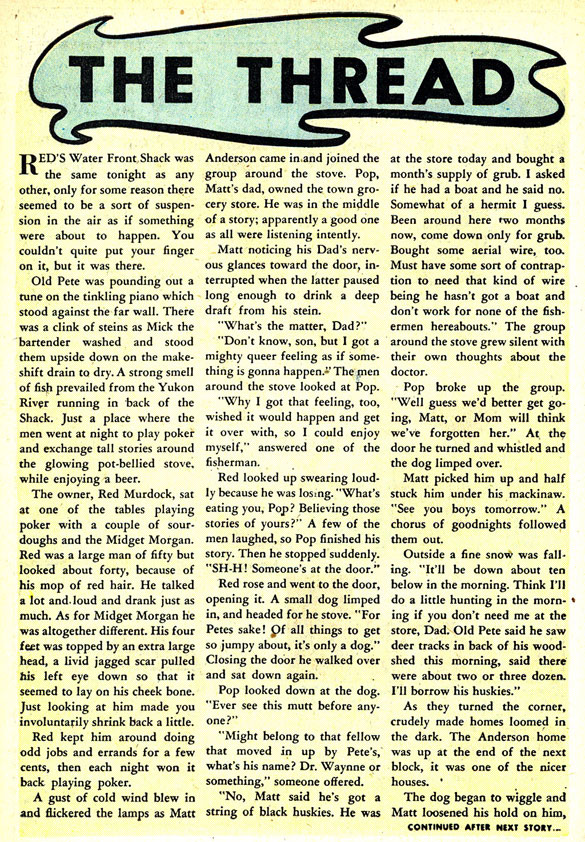
text story "The Thread" in Journey into Unknown Worlds (1950 series) #13 (Marvel/Atlas, October 1952), author uncredited (Stan Lee?)

And now, by United States Postal Law, I can now mail this blog via Second Class mail.

More? Well, yes! Soon!

Twain and Einstein meet Team America!

When anyone mentions the dynamic duo of Mark Twain and Albert Einstein, I hope you think of the Fantagraphics-published comics of Michael Kupperman, which regularly team-up these two wild-haired, hard-hitting action adventure heroes: Twain and Einstein!


Panels from Tales Designed to Thrizzle Volume 2 (November 2012); script, pencils, inks, colors, and letters by Michael Kupperman

You really should not miss Twain and Einstein's wacky, way-out adventures, and you can find them in the Tales Designed to Thrizzle comic, which we can only hope Mister Kupperman is going to produce more issues of. I can't live without this!:


Or this!


In fact, Kupperman's adventures of Twain and Einstein span not only all of time and space but all comics genres!


At the same time, though, I often wonder if Kupperman's twenty-first century comics were influenced or by inspired by a different comic book from 1982...Captain America #269!


Panels from Captain America (1968 series) #269 (May 1982); script by J.M. DeMatteis; pencils by Mike Zeck; inks by John Beatty, Mike Zeck, and Joe Rubinstein; colors by Bob Sharen, letters by Jim Novak

There's Twain, and herrrrrrrre's Einstein!


The Adventures of Twain and Einstein! As we sometimes say about Batman...Captain America Did It First!


Bonus Special Weirdness Element to This Issue: it guest-stars Team America!


I cannot do justice to this issue unless I quote liberally from its plot summary at the Grand Comics Database.
Cap is taking part in a charity motorcycle event with Team America when a giant monster appears and captures a Nobel Prize winner who is in the audience; Cap and Team America follow the monster through a transporter tube and find themselves in a quaint little town peopled by the world's greatest thinkers from the past. This is all part of the Mad Thinker's agenda to surround himself with suitable companions to stimulate his intellect, but when Cap finds the missing Nobel members about to be turned into robots, he and Team America bring an end to the Thinker's Machiavellian plan.


Okay, Michael Kupperman, it's your move...now I want to see Twain and Einstein team up with Norwegian classical composer Edvard Grieg!


365 Days of KirbyTech, Day 7: The Silly Contraption [Unidentified KirbyTech]


Pin-up from Fantastic Four Annual #2 (September 1964), script by Stan Lee, pencils by Jack Kirby, inks by Chic Stone, colors by Stan Goldberg, letters by Artie Simek

Well, if Reed don't know, ain't nobody who knows!

Monday, January 06, 2014

The Rapturous Rainbow Rings of the Martian Manhunter!


Panels from (top to bottom) Detective Comics #300, 302, 304, 305, 307, 319, 322, 323, 324 (3 panels), 325

365 Days of KirbyTech, Day 6: The Zombie Gorillas of the Tyrannical Count

They're pretty much exactly what it says on the tin: they're Zombie Gorillas.


Cover of The Sandman (1974 series) #3 (July 1975), pencils by Jack Kirby, inks by Mike Royer


Sunday, January 05, 2014

Ten of a Kind: A Study in Four Colors


(See also. And there's more Ten of a Kind here.)

365 Days of KirbyTech, Day 5: Reed Richards's Electromagnetic Meson Velocirator


Panel from Fantastic Four (1998 series) #1 (January 1998), script by Scott Lobdell, pencils by Alan Davis, inks by Mark Farmer, colors by Liquid!, letters by Richard Starkings and Albert Deschesne

The Electromagnetic Meson Velocirator! Now that's a big triple-barelled name for something that might more easily be described as Big Ben Grimm Jet Pack.


In fact, and because it's designed and built by Reed Richard,s it's even better than a jet-pack, because it's completely carbon-neutral: it uses the magnetic field of the Earth as power! I just hope Ben Grimm took his Discover Card out of his wallet first. Because it doesn't use fuel and it can travel up to Mach 10 (even while carrying a quarter ton of Aunt Petunia's favorite blue-eyed nephew) while it transmits electromagnetic scans back to home base. Wow! And that was in 1998. It's 2014, for Pete's sake...where is my Electromagnetic Meson Velocirator? I was promised an Electromagnetic Meson Velocirator!

Caution: do not use Electromagnetic Meson Velocirator around open flame.


Did we mention the Electromagnetic Meson Velocirator has an auto-ignition? Now How much would you pay?


What's more, it can duplicate the rare scientific process known as The Bullwinkle Effect.


Warning: be sure to install the optional brakes on your Electromagnetic Meson Velocirator.


Today in Comics History: Robert Mitchum deducts the secret origin of Oregon


Panel from the Johnny Law story "A Shadow of a Doubt" in Big Town #15 (May-June 1952), pencils and inks by Irwin Hasen