Funny animal comics. They're easy to define by their three separate words: they're funny. They've got animals in 'em. And they're comics. Simple enough, ain't it? When you pick up one, you pretty much know what to expect: gags, chases, cats darting after mice, mice hitting cats with hammers, everybody has a good laugh and nobody ever gets really hurt. That's another definition, isn't it? Even in the most violent...say,
Itchy & Scratchy Comics...Scratchy can get his head chopped off with a lawnmower but we larf and larf and larf because there's no sense of permanence in there. You think superhero comics with their revolving doors of mortality defy the inevitability of death more than any other genre of comic? You think a genre where only
Bucky Jason Todd Uncle Ben Gwen Stacy remains dead is the extreme? Well, remember this, bucko: it's all good fun 'n' games in funny animal comics, and the best thing is, nobody ever shuffles off their mortal coil.
Well, not always. As another funny animal once quipped, "Not all animals are created equal." And I'm not specifically talking about more adult-oriented funny animal comics like
Critters or
Usagi Yojimbo or
The Adventures of Captain Jack or even the original Eastman/Laird
Teenage Mutant Ninja Turtles. No, I'm talking about as deathproof as you can get:
Disney comics. Black Pete or the Phantom Blot may have threatened Mickey or kidnapped Minnie but nobody ever got worse than a punch in the snout. Magica da Spell or the Beagle Boys have it in for Uncle Scrooge's money bin, not for his life. Sure, Bambi's mom and Simba's dad...I'll give you those. But good old-fashioned fun-for-all-ages Disney comics don't feature discussions of mortality.
Except...

I wrote in some length
here about my collection of late sixties Top Comics, which, as helpful Martin Allen points me to in the
comments, re-published three issues of Gold Key's
Uncle Scrooge comic, two of which I've already covered ("The Great Steamboat Race" in issue #3 in that link above, and "The Doom Diamond" in issue #1
here. Both wonderful, wonderful Carl Barks stories: certainly not the stories he's best-known for or even where he was absolutely on top of his game, but they hold a special, dear place in my little red satin heart because they were my first exposure to Uncle Scrooge. But I have all three of the Top Comics Scrooge issues...what of issue #2? Well, as I mentioned before, even in those days before Disney/Gold Key/Top Comics printed credits in their books, I could clearly tell which stories were the work of the Good Duck Artist, even though I didn't know his name. "The Great Steamboat Race" and "The Doom Diamond" were clearly the work of that same genius I only much later came to know as Carl Barks. But issue #2, "King Scrooge the First" (originally published in Gold Key's
Uncle Scrooge #71)...
that one puzzled me. The artwork was very clearly
not that of the Good Duck Artist, but the story was weird and mystical and oddly compelling, oddly unsettling in a way, and I kept returning to it as a tiny stuffed bull to read it again and again. Why did it compel me? And more to the point, why was it so
vaguely disturbing to me? To give you the full effect, let me recap the story in an
extreme abridgement, with the magic of Blogger, a scanner, and some IMG SRC tags. Be certain you're sitting down: I have not one but
two startling twist endings for you at the end of this story.
As "King Scrooge the First" begins, McDuck and his posse of nephews are out for a walk and encounter a fortune teller:

All panels in this post are from Top Comics: Uncle Scrooge #2 (1967, originally published in
Uncle Scrooge #71, October 1967), art by Tony Strobl and Steve Steere
Scrooge scoffs, but the Swami knows how to pique the canny old duck's interest:

But, as another sentient water-animal might opine, "It's a trap!" The fortune teller hypnotizes Scrooge, Donald and the boys and whisks them away to a ghost town in the middle of the Saharan Desert, deserted for almost four thousand years:

Clearly, those webbed feet aren't taking our favorite ganders home:

Abandoning Scrooge and the others, the Swami spies on them from a distance. (Hey, how can
he remember a town that hasn't buzzed with life since 2033 B.C.?)...

...and again hypnotizes them, making them believe they are living in the age the city in the desert boomed and bloomed:

In their Shirley Maclaine-flavored past-life recall, of course even an ancient Donald is pretty much still Donald:

...and so, rather disturbingly for a funny animal comic, so are Huey, Dewey, and Louie. Warning:
duck bondage. (Ding ding ding go my Google referral hits!) Where are when we need you, Doctor Wertham?

Slaveducks can wait, because the city is being attacked!:

...all as part of a cunning plan by the Swami to make Scrooge, Donald, Huey, Dewey, and Louie re-enact a specific battle in history. But what's so important about
this battle?:

Wait a minute! Does this invading vandalduck look familiar?

Of course he does: it's the
Swami as he existed back in ancient times! Ah,
now it starts to come together...the Swami is thousands of years old! That's not the twist I promised you, but it's a good one. But how did he become immortal?

Back in ancient times, the Swami demands one chest from King Scrooge's treasure trove to bargain for their safety. What's in that chest? Not jewels, not coins, but two small urns filled with powder. Whoa, that's a lot of work just for some paprika, isn't it? Another piece of the puzzle comes together when the ancient Swami reveals he just swallowed a
powder of immortality:

Back in the present, after several pages of running about, ancient fortunes shuffled back and forth, and lots more hyp-mo-tizing, the Swami uses Scrooge's buried memories to rediscover the hidden cache of treasure. Scrooge, of course, turns the tables and the Swami is soon tied up, no doubt using an unbreakable Junior Woodchuck knot. He bargains for his freedom, asking for only one item from the treasure trove—Scrooge can keep the rest. It is, of course, that same chest that once held the two urns and now only holds one:

Before baffled duck eyes, the Swami turns into his true age: an ancient, weary duck four thousand years old:

...a duck long tired of immortality in an age when his comrades and slave girls long ago died...

W-w-w-wait a minute. That's how it ends?
That's how this story ends? The story
ends with the ancient swami wandering off into the desert to
die? Whoa. Whoa. That's heavy stuff for a funny animal comic. Even though it doesn't come right out and portray the scene or say the D-word, the four-thousand year old duck is likely
dead, dissolved into dust, before Scrooge can even dive into his new treasure.
Now I remember why this comic book gave tiny, tiny me a bit of the heebie-jeebies—that's a heady and adult theme to pull off so effectively in a Disney comic book, not simply the concept of death, but the idea of a
man duck so weary of life that he effectively commits suicide to head into the afterlife. Two years later in 1969's "Requiem for Methuselah,"
Star Trek would cover much the same ground, but this is deep, deep stuff for Disney in 1967, isn't it?
But the ending of this comic book story is only the first of the twists I promised you waaaaaay up there. The second one had a much longer pay-off because until tonight when I was researching the story on the web, I had it firmly fixed in my head as one of the lesser Uncle Scrooge stories by one of Carl Barks's successors—because even a casual comic book fan can glance at that art by Tony Strobl and Steve Steere and note that, while competent, that ain't Unca Carl. And yet, the scope and grandeur of the original story, the deep theme above and beyond the usual limits of Disney comics...well, that's a very good
imitation Barks, isn't it? Almost uncanny...
Unless you're a Duck scholar or historian, maybe you didn't see this twist coming any more than I did, but I did not realize until tonight that "King Scrooge the First"
was created by Carl Barks: it is a script he wrote before he retired in 1966, leaving the artwork for the story to be drawn by Strobl. In other words, I've been scratching my head over this story for years, thinking it was the next best thing to a Barks story...and it
is a Barks story.
I love serendipitous discoveries like that, where your preconceptions suddenly turn on their head and something you never knew in dozens of readings of a favorite comic book suddenly becomes obvious. I have no idea whether "King Scrooge the First" was Barks's meditation on growing old (he'd have a very long career painting the Ducks following his retirement), but even if it was simply a story he never got around to finishing himself, "King Scrooge the First" suddenly sparkles and shines in a different light in my collection: a story I loved despite its apparent non-Barksness now shines with a new significance. The man who brought action, danger and adventure—and even the hint of mortality—to a buncha cartoon ducks continues to surprise me even forty years after this book was published. That's yet another reason I love old comic books I have a personal attachment or connection to: there's always some facet of the gem waiting to be discovered even long years after I first read 'em.
I hope
you do the same. Take your lesson from Scrooge: comics are not meant to be sealed away and never read. Pull your comics out of their longboxes and their Mylar sleeves and give 'em another look. Dive around in them like a porpoise. Burrow through them like a gopher. Toss them up and let them hit you on the head. But most of all,
read 'em. That's where the
fun is.

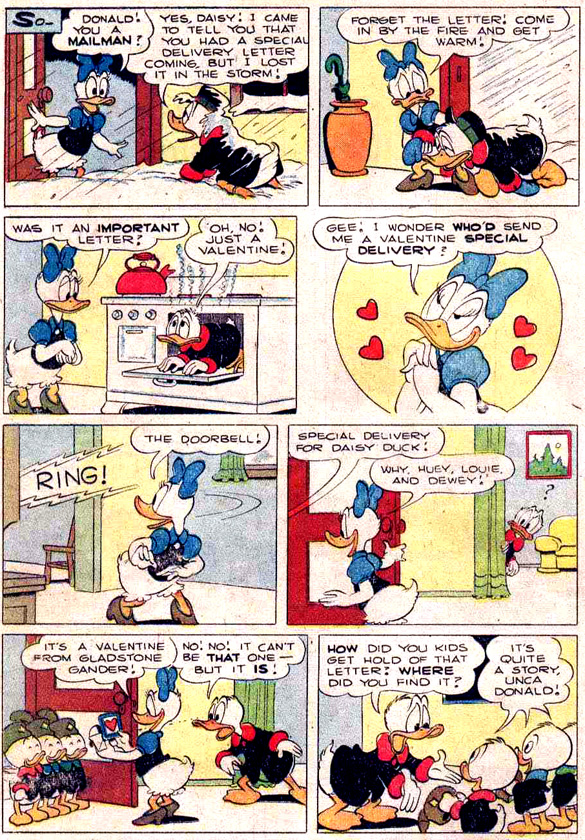


 There's a type of Carl Barks Donald Duck story commonly termed "the brittle mastery of Donald Duck," in which every


 Panels from "The Olympian Torch Bearer" in Walt Disney's Comics and Stories #286 (July 1964), script, pencils, and inks by Carl Barks, colors by Western Publishing Production Shop, letters by Garé Barks