Sunday, September 11, 2011

365 Days with the Warriors Three, Day 254


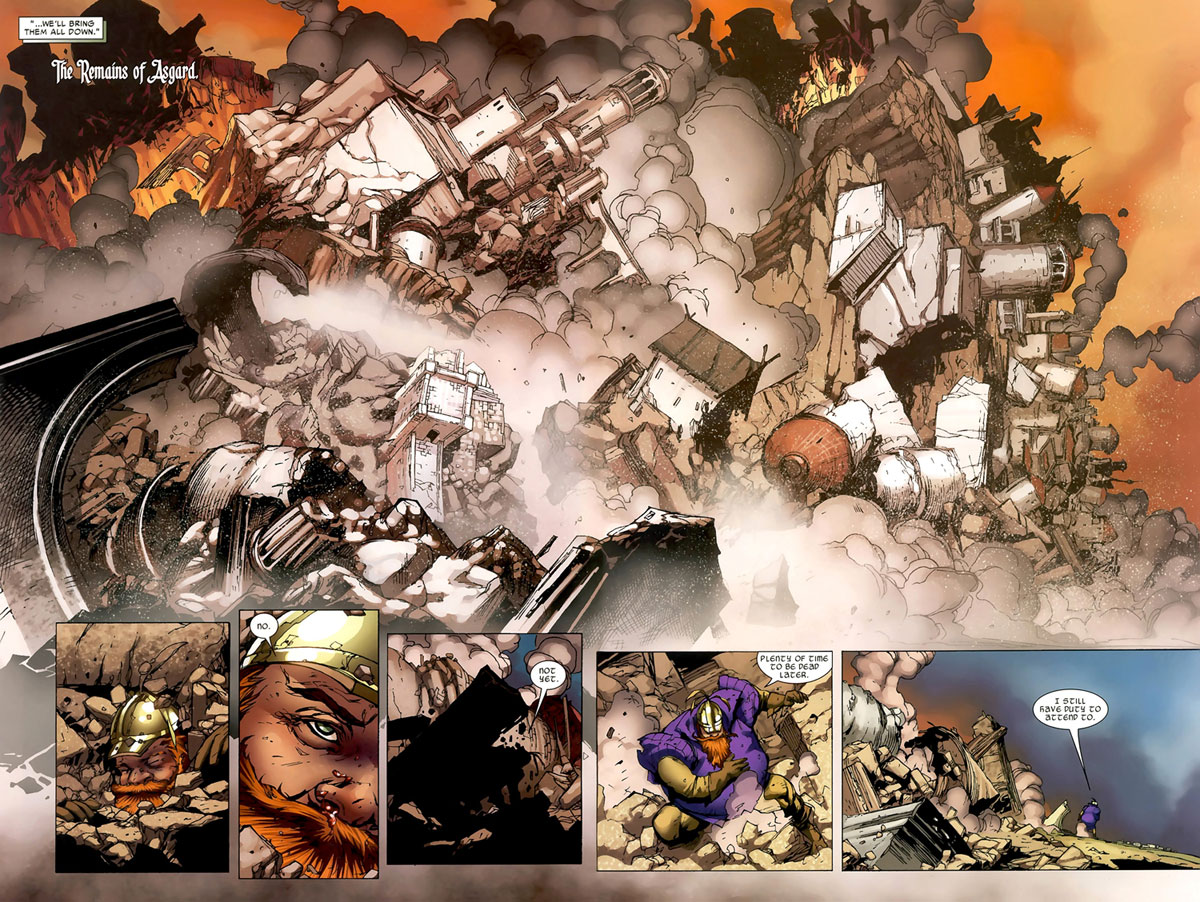
Two-page spread from Thor #609 (June 2010, script by Kieron Gillen, pencils by Billy Tan, inks by Matt Banning, colors by Christina Strain, letters by Joe Sabino

(Click picture to enlarge)


Ten of a Kind: With Liberty and Justice for all


(More Ten of a Kind here.)


Saturday, September 10, 2011

365 Days with the Warriors Three, Day 253


Panel from Hostess ad Thor in The Ding-a-Ling Family, appearing in Marvel comics cover-dated January-February 1978. Pencils by Sal Buscema, inks by Joe Sinnott, letters by Irving Watanabe

Stan Lee Saturdays #9: Face Upside-Down, True Believers!


Cover of The Official Marvel No-Prize Book one-shot (January 1983), cover art by Michael Golden


Friday, September 09, 2011

Atlas/Seaboard Week, Day 5: She's gonna get you from behind

Let's wrap up Atlas/Seaboard Week with a quick romp through the monochromatic world of one of their black-and-white magazines. Say, y'know how some characters are born with names that ensure they're going to become larger-than life superhuman heroes or villains? Guys like Roy G. Bivolo, Edward Nigma, William Tockman, Julian Day, or Hubert J. Starro? Yup, a moment's weakness or your parents and the wrong baby-naming book can lead to the difference between your becoming an insurance agent and a world-conquering tyrant bent on destruction and despair. Oh, wait, there's not that much difference between those two after all.

Consider the case (in my Rod Serling voice) of the young girl known as...Devilina! ("Is that Polish?" asks a character.)


from Devilina #1 (Atlas/Seaboard, January 1975), script, pencils and inks by Ric Estrada

She's the star of one of Atlas's answers to black-and-white horror and occult comics like Warren's Eerie and Creepy and Marvel's Haunt of Horror, Vampire Tales and Monsters Unleashed. (The earlier Monsters Leashed proved unpopular with its target audience, although it sold well in pet stores.) Intended for an older audience that those who read Atlas's color comics (and definitely not for a little stuffed bull, I gotta tell ya), Devilina attempted to leap off the shelves of the newsstand with the catchphrase "Illustrated Stories of Female-Filled Fantasy." Oh, cool, then!...heroines like Hermione Granger, Lessa of Pern, and Buffy the Umpire Slayer!


cover of Devilina #1 (Atlas/Seaboard, January 1975), art by Pulojar

Or, it could be one of, y'know, those kinda books.

Devilina (I'm not certain of her last name. It may be "Smith") comes by her unique moniker honestly, at least: she's the honest-to-goodness badness kid sister of Satan! So informs Satan's mom to the Lord of Lies in a set-up that could have led to a series you could elevator pitch as My Two Dads...in Hell!


Instead, Devilina is allowed to grow up on Earth as a normal human being (except for, say, the toys bursting into flames thing). She's a modern liberated girl in the vein of Mary Richards, That Girl, and Pepper Anderson. No attending the State University of Hell for her!


Poor Devilina can't catch a break. Just like Jimmy Carter, she's bewildered and bedeviled by her brother at all turns, with the occasional boyfriend bursting into flames. Well, that'll happen.


The adventures of Devilina: the magazine that serves to prove the point that Satan is a jerk.

Most of us in Devilina's pointy, pointy cloven shoes would, say, move to Europe or get a job in telemarketing, but The Undevine Ms. D chooses to confront her bro head on by...um, dressing like a biker chick and lighting some incense. It's the Devilina Mission Statement!:


She's accompanied in her battles against the forces of eternal darnation by ace photographer "Snap" Kodiak, himself the son of a twig and a Canadian bear. Here "Snap" shows off the same crack photo technique that won Jimmy Olsen a Pulitzer Prize for that photo of Superman with a lion's head:


from Devilina #2 (Atlas/Seaboard, May 1975), script, pencils, and inks by Ric Estrada

The series featured ongoing subplots but each story was complete in and of itself. Here at the end of issue #2's story, Devilina and pal deliver the last lines before their mutual bursting into laughter and the end title freeze frame, if this were a 1970s cop TV show:


Devilina lasted only two issues, so we'll never find out if she triumphed over her jerky older brother. Seeing as in 2010 the world has not been turned into a molten mass of magma lorded over by pitchforked demons, but considering that the Kardashians exist, I'm going to go out on a limb and guess that it was a draw. Still: heckuva catchy battle cry, huh?


Devilina's adventures were only part of her anthology black-and-white comic, the remainder of both issues taken up with horror stories, fantasy tales, and epics of topless maidens. Here's the world's most specific horoscope:


from "The Prophecy" in Devilina #2, script, pencils and inks by Suso

I'm sure that these two things have nothing to do with each other in the slightest:


from "Merchants of Evil" in Devilina #1, script by John Albano, pencils and inks by Jack Sparling

The Daryl Hannah Story!:


Panels from "Lay of the Sea" in Devilina #1, script by Gabriel Levy, pencils and inks by Leo Duranona

So, there you go: Devilina. Any last words, Satan?


Text page on Atlas's horror and suspense magazines and comics, from Devilina #1:


Thus ends the more-complicated-than-I-thought-it-would-be but refreshingly-rewarding Atlas/Seaboard Week. But that's only five titles out of the wide Atlas Galaxy of Stars that I've looked it...what about the rest? Will you ever get to read a little stuffed bulls take on Iron Jaw, Police Action, Targitt, Wulf the Barbarian or Weird Suspense featuring The Tarantula? You betcha! I'll pick up again at a later date with Atlas/Seaboard Week II: Tiger-Man Boogaloo! Just don't expect too many installments of this feature...just like Atlas itself, we're gonna run through all the titles in just a few issues. Until then, though, in the words of Atlas's tippy teen Vicki:


house ad from Vicki #1 (Atlas/Seaboard, February 1975)
365 Days with the Warriors Three, Day 252


Panel from Thor #621 (May 2011), script by Matt Fraction, pencils and inks by Pascual Ferry and Salvador Larroca, colors by Matt Hollingsworth and Ulisses Arreola, letters by John Workman


Thor Hard: With a Vengeance

Hey, guys, remember when Thor wanted vengeance? D'you think he's cooled down by now?

Panels from Thor #396 (October 1988), script by Tom DeFalco, pencils by Ron Frenz, inks by Don Heck, colors by Christine Scheele, letters by John Workman


Oooookay, Mister Thor. I can come back next week to sell you these Bull Scout cookies.


Thursday, September 08, 2011

Atlas/Seaboard Week, Day 4: And he strikes like Scorpion

I've poked a lotta fun at some of the Atlas/Seaboard comics this week, but let me take a deep breath from my giggling fits about Planet of Vampires so we can turn back the cover on a comic that, for about an issue and a half, is not only one of the better (or best?) comics Atlas published, but it's a pretty darn good comic across the entire funnybook industry of 1975. That depends, of course, on your level of enjoyment of Howard Chaykin.

Some fans love him (I'd count myself among them for most, not all, of his works), some loathe him, and there's a whole bunch of contemporary comic book readers who probably had never even encountered him until he returned to Marvel and DC in the past few years. (I'm lookin' forward to Avengers 1959 from Chaykin later this year). If you like Chaykin, you'll like The Scorpion. In many ways the book is the archetypal Atlas/Seaboard title: big-name creators, big splashy first issue with intriguing concepts and ideas, but swiftly descending down the slippery slope until the final issue #3 or 4 bear no resemblance to #1.


Cover of The Scorpion #1 (February 1975), art by Howard Chaykin


Hey, this Scorpion guy looks kinda familiar, huh?


Cover of Marvel Premiere #56 (October 1980), Howard Chaykin and Terry Austin


That's because, more or less, Marvel's Dominic Fortune is the Scorpion. A combination of missing deadlines and arguments over control of the character led Chaykin to depart The Scorpion after #2, but it's clear he had plenty more stories to tell about the character almost immediately: Fortune debuted in Marvel's black-and-white magazine Marvel Preview #2 later in 1975. He's never been a major headline character, but the backlist of Dominic Fortune adventures (both by Chaykin and by others) is fairly extensive. He's appeared in a backup series in The Hulk magazine (a series never finished when the magazine was cancelled), a one-shot Marvel Premiere issue, various appearances in Spider-Man and Iron Man books, Marvel Comics Presents, and a couple miniseries, only one of which was collected as a trade. Fortune completists, start haunting those back issue bins!

But let's get back to The Scorpion. Ish #1 kicks off with a couple of stylish splash pages which lay out the concept of the character...no complicated or drawn-out origin tale for this guy!


First two pages of The Scorpion #1 (February 1975), script, pencils, and inks by Howard Chaykin; letters by Annette Kawecki


I especially love the first page with its snapshot history of this mysterious long-lived man and his business card reminiscent of This Gun for Hire's Paladin, one of fiction's most famous calling cards.


The Scorpion is your classic Chaykin character: both smooth and suave but rough and rugged, he's a troubleshooter/soldier-of-fortune in the 1930s whose only duty is to the job at hand and the payment he collects on finishing it. But of course, as with virtually every Chaykin character, there's plenty of gorgeous gals...


...and high-adventure action and endangerment. Here's a nicely-designed single-page sequence showing The Scorpion's skill in the clouds aboard classic planes of the '30s.


In fact, the action centerpiece of issue #1 features Chaykin's detailed and authentic art of planes, cars, and a motorcycle. A chase sequence in comic books is really tough to pull off; it never has the pace or immediacy of a similar chase on film. Chaykin uses three small panels to set up the action with style and energy; you're never left wondering what's going on here. This stunt would make James Bond or Indiana Jones green with jealousy.


Nicely done, Scorpion One! You can see the erosion set in, though, immediately on sight of the cover of issue #2. Ernie Colon's a great artist, but his style isn't Chaykin's, and this is another "this scene does not happen in this comic" cover. Yep: sadly, the Scorpion does not battle Frankensteins in this book.


Cover of The Scorpion #2 (May 1975), art by Ernie Colon


There's still some great Chaykin artwork in this ish, but it's wildly uneven, being inked by a wide assortment of artists—Bernie Wrightson, Mike Kaluta, and Walt Simonson all chipped in to help Chaykin hit the deadline. Fine artists all, but too many inkers in one book can give you reader-whiplash if you turn the page too quickly! Here's a nice action sequence, but it doesn't look much like Chaykin to me. Whether he was rushed or the pencils were overwhelmed by the inks I don't know, but I have a feeling this sequence would have been stronger if Chaykin had inked himself.


First two pages of The Scorpion #1 (February 1975), script and pencils by Howard Chaykin; nks by Bernie Wrightson, Mike Kaluta, Walt Simonson and Ed Davis; letters by Annette Kawecki


Still, there's moments of charm. Here's one of the female characters showing she's nobody's dainty hostage:


And there's a lovely sardonic fade-out at story's end which reminds us exactly why The Scorpion does his job.


By issue #3, Chaykin's gone completely, and WHAT THE SAM SCRATCH IS THIS?!?!


Panel from The Scorpion #3 (July 1975), script by Gabriel Levy, pencils by Jim Craig, inks by Jim Mooney


Our pal Scorp is now a 1970s swing-from-the-buildings hero in the vein of Spider-Man or Daredevil. Wha...huh? How did the 1930s character turn into a modern-day superhero? "That's another story for another issue," the narration promises us. (Of course, this is Atlas' final issue of The Scorpion.) So, just another high-wire super bashing evil megacriminals in the face, right? Well, not quite: the 1975 Scorpion fights Nazis. Which, admittedly, could just be a way to have a fairly easy superhero career. "Hey Scorpion, c'mon! We're all teaming up to fight Major Mayhem and Colonel Panic in Megalopolis Park!" "No, thanks...I'm busy lookin' for Nazis."


Luckily for him they seem to be as ubiquitous as in the Marvel and DC Universes, and not just Nazis...Super Nazis.


The thinking here apparently being "Hey, the Red Skull and Doctor Doom, those are two cool characters! Can we use them?" "No!" "Okay, let's Amalgam them!" Then there's a heck of a deus ex machina in the shape of a mystical vision of the World Trade Center, the only building in New York with a "sewage-to-energy converter."


Um, okay! We can buy that, story! Just as long as there's no more fantastic deus ex m's being tossed at us further on in the story...


Oh, for crying out loud, story!

Now this is interesting: the only published letter column for The Scorpion, from issue #3. Oddly enough (and to Atlas's credit), much of the response was negative. One complains "the art wasn't so great" (well, sure, your appreciation of Chaykin may vary). Another kevtches that there's not enough backstory to enjoy the character. Hey, I liked that a lot. It would have been fun to gradually learn more about his past later on rather than an origin story or huge infodump in issue #1. And then there's a reader complaining that the 1938 setting prevents team-ups and a cohesive "Atlas Universe." Oh boy, fans...you really do just want the same old stuff again and again and again, don't you?


Letters column from The Scorpion #3


And thus rides The Scorpion off into the setting sun of Atlas/Seaboard, but at we've got Dominic Fortune, huh? (Psst, Howard, your secret is safe with me: I'll never tell Marvel he started out as an Atlas character!)


"What's Happening with Atlas" text (half-)page from the April '75 Atlas comics:


Tomorrow: the Roy G. Bivolo/Edward Nigma of the Atlas Universe!