Monday, October 22, 2007

A Wodehouse a Week #26: Louder and Funnier

A Wodehouse a Week banner

Week 26. With today's entry I'm now half a year into the Wodehouse a Week project, one-quarter or so of the way through the whole shebang, so let's have a little treat from the Bully Plum collection, shall we? This week's book is the essay collection Louder and Funnier (1932), an anthology of comic essays and observations originally written and published in Vanity Fair magazine. Yes, that's right—you could have read all these pieces as they came out, or you could simply wait for the trade.

A quick perusal of some of the essay titles—"An Outline of Shakespeare," "Fashionable Weddings and Smart Divorces," "On Ocean Liners," "The Decay of Falconry," "Thoughts on the Income Tax"— tells you we're not precisely in Jeeves and Wooster territory. Well, yes, there is a piece on "Butlers and the Buttled," but it's a caution that the butler you think you may get won't be the butler out of British lore:
But then, those were the days when butlers were butlers. You never met one under sixteen stone, and they all had pale, bulging eyes and tight-lipped mouths. They had never done anything but been butlers, if we except the years when they were training on as a second footmen. Since then there has been a war, and it has changed the whole situation. The door is not opened to you by a lissome man in the early thirties. He has sparkling, friendly eyes and an athlete's waist, and when not opening door he is off playing tennis somewhere. The old majesty which we used to find so oppressive between 1900 and 1910 has given way to a short of cheery briskness. Formality has disappeared. I know a man whose butler is his old soldier-servant, and his method of receiving the caller is to open the front door about eleven inches, poke his head through and, after surveying the visitor with some suspicion, say in broad Scotch, "Whit d'ye want?"
As I read Louder and Funnier, I reflected that butlers aren't the only thing that have changed dramatically, especially when I considered these pieces all originally appeared in Vanity Fair magazine. Wodehouse's light, dry, observational humors were a regular staple of VF during the late 20s and early 30s, which is hard to reconcile in your little stuffed head if all you know is the modern-day VF. The VF of Wodehouse's era ceased publication in 1936 (Wodehouse continued to write for The Saturday Evening Post and other periodicals) and was not revived as a magazine until the 1980s. By then magazines were in many ways different beasts, belching their litters of subscription cards as they padded boldly into a brave new world. Here's the Vanity Fair of Wodehouse's age:
Vanity Fair 1920s-30s


And here's the VF we know today:
Vanity Fair 1990s-2000s


Nothing wrong with a magazine that spotlights leggy supermodels and a naked Miss Keira Knightley, I always say, and in between its celebrity profiles, Vanity Fair still upholds a fine tradition of investigative journalism, political reportage, and Dominick Dunne's Hollywood courtroom shenanigans. (The closest thing we have today to Wodehouse's Vanity Fair is probably the still-literary New Yorker. I bet Wodehouse woulda liked the cartoons.) But the age of light humorous pieces with titles like "A Word About Amusement Parks" in Vanity Fair seem to have passed along with homburg hats and the pince-nez.

Which is a pity, because the world needs more magazine articles like this one on the British writers:
Everyone who is fond of authors—and, except for Pekingese, there are no domestic pets more affectionate and lovable—must have noticed how alarmingly scarce these little creatures have been getting of late. At one time London was full of time—too full, some people used to think. You would see them frisking in perfect masses in any editorial office you happened to enter. Their sharp, excited yapping was one of the features of the first- or second-act intermission of every new play that was produced. And in places like Chelsea and Bloomsbury you had to watch your step very carefully to avoid treading on them.
Where have all the authors gone? Why, they've migrated to Hollywood to write screenplays for the big studios:
Do you realize that all that year I was away from London, when everybody supposed that I was doing a short stretch at Dartmoor, I was actually in Hollywood?...Authors in Hollywood are kept in little hutches. In every studio there are rows and rows of these, each containing an author on a long contract at a weekly salary. You see their anxious little faces peering out through the bars. You hear them whining piteously to be taken for a walk. And does the heart bleed? You bet it bleeds. One has to be very callous not to be touched by such a spectacle....

I do not say that all these authors, or indeed, a majority of them, are actually badly treated. Indeed, in the best studios kindness is the rule. Often you will see Mr. Warner or Mr. Lasky stop and give one of them a lettuce. And the same may be said of the humaner type of director.
He devotes an entire article to the art of swatting flies, and a lovely alternate sea-side Wimbledon tennis tournament, tips for gambling and losing, and there's this wonderfully bold essay on music hall entertainment which proves he surely must have been being paid by the word and boldly flaunting that fact:
As a matter of fact, I don't think I ever saw Lottie Collins. But many is the morning when you could have heard me rendering her best-known number in a shrill treble in my bath. I suppose it is forgotten now, but here is how the refrain went. You start at the top and read straight down.

Ta-ra-ra-boom-de-ay!

The author always considered that a pretty good lyric, and its popularity shows that the public endorsed his view.
There's a wonderful comic history of Shakespeare:
In his early youth he seems to have had the idea that there was a good living to be made out of stealing rabbits from the preserves of the local squires, and it was only when approaching years of discretion that it suddenly occurred to him that a man could do much better for himself by stealing plots. In the year 1591 he began to write plays, and from then onward anybody who had a good plot put it in a steel-bound box and sat on the lid when he saw Shakespeare coming....

'What on earth does "abroach" mean?' Burbage would ask, puzzled, halting the rehearsal of Romeo and Juliet.

'It's something girls wear,' Shakespeare would say. 'You know. Made of diamonds and fastened with a pin.'

'But you say "Who set this ancient quarrel new abroach?" and it doesn't seem to me to make sense.'

'Oh, it's all in the acting,' Shakespeare would say. 'You just speak the line quick and nobody'll notice anything.'

And that would be that, till they were rehearsing Pericles, Prince of Tyre, and someone had to say to somebody else, 'I'll fetch thee with a wanion.' Shakespeare would get round that by pretending that a wanion was a sort of cab, but this only gave him a brief respite, because the next moment they would be asking him was a 'geck' was, or a 'loggat,' or a 'cullion,' or an 'egma,' or a 'punto,' or a 'span-counter,' and wanting to know what he meant by saying a character had become 'frampold' because he was so 'rawly.' It was a wearing life, and though Shakespeare would try to pass it off jocularly by telling the boys at the Mermaid that it was all in a lifetime and the first hundred years were the hardest and all that sort of thing, there can be little doubt that he felt the strain.

So if he wanted to steal plots, good luck to him, say I for one.
Grand stuff, and a lot of fun. But is that in and of itself a good enough reason to choose Louder and Funnier as the quarter-mark celebration for "A Wodehouse a Week?" Answer: no! I chose it because while it's not my favorite Wodehouse writing, it is my favorite Wodehouse edition of any in my collection.


You can see it in this photo: a small hardcover published by Bernhard Tauchnitz (German publishers of much British literature, in English, on the continent). It's not in grand shape: it has a worn, stained, cracked binding, and the pages are brittle and I have to be careful turning them. (It's a bit difficult with hooves.) With a bit of rare precision my Wodehouse notebook tells me I purchased this at a antique shop in Oxford (England, not Mississippi) for £3.50 on November 11, 1992. My diary from that trip says:
Found a great antique shop in Oxford in which I could have spent several hours—I felt just like Lovejoy. Lots of cameras, jewelry, lanterns, china...and books! A tiny little bookshop in the corner in which I finally found a cloth PGW. It was a great little pocket copy of Louder and Funnier in which someone has used the endpapers as a sort of Wodehouse scrapbook, pasting in newspaper articles and press clippings about PGW. I imagine it drives down the value of the book...I got it for £3.50—but I think it's great to think that whoever owned this book loved PGW as much as I do.
My book: take a look:


(You can click on most of the photos and scans in this post to see larger close-ups on Flickr. Click on the "All Sizes" button once you get there to make the image much larger.)


It was given to someone on Christmas, 1932, and they pasted in clippings starting with ones dated 1935 and straight through 1952. There's Wodehouse's 1935 Who's Who entry...


A 1946 review from Time of last week's Wodehouse, Joy in the Morning, with which I could not disagree more when it says Wodehouse is "not absolutely in midseason form" and the novel "only has a trace of real mirth":


Short reviews from Truth magazine (not to be confused with the modern-day religious periodical). I can't find anything online about a British magazine called Truth but these short reviews remind me a bit of the "In Brief" reviews at the back of the New Yorker or even those in Publishers Weekly. The one in the middle refers to the furor over his controversial wartime broadcasts and cautions "If you ever liked Wodehouse, and his wartime career has not—as it may have—taken all charm from him, here is the mixture-as-before-the-war."


Pasted onto the back endpaper (now brittle enough to have fallen into two pieces and missing the final few column inches) is a longish piece from 1947 on the same controversy, written by Wodehouse's most vicious attacker in the press, the columnist "Cassandra".


This isn't the famous 1941 Cassandra attack on Wodehouse that painted him as "Quisling," "selling the country" and "worshipping the Führer," but Cassandra is still vicious and venomous and crowingly triumphant over influencing the British people to ban Wodehouse's works (there's a couple other clippings in this book about British town libraries banning the books) and call for his trial as a traitor. Cassandra is clearly an angry man and the acid of this piece is still tart and hateful sixty years after its publication. History has been kinder to Wodehouse, of course. But this pasted-in souvenir of a time when many people called for the head of my favorite writer can still put a chill up your spine. (Incidentally, Wodehouse never wrote the book "about the war" he refers to and Cassandra condemns in the piece.)

In addition to serving as a scrapbook of Wodehousiana, my Louder and Funnier has also been extensively annotated with marginalia, notes, and writing by its previous owner. He or she carefully corrects typographical errors in the Tauchnitz text:


...adds handwritten footnotes with the care of a Norton Critical Edition editor:


...wry observations on the "current" era of a decade past its original writing:


He or she occasionally underlines or circles jokes:


...and adds quotations and headnotes to illuminate the text:


I love...I absolutely love this edition. It's the only copy of Louder and Funnier I have in my collection, and really, with a jewel like this, who needs another one? Even if I search high and low I'm not going to find another copy as unique and loved as this one. You can buy a copy if you like by clicking on the Amazon link to the right, but note the price: it ain't gonna cost you a mere £3.50! (Oh, okay, here's a link to a more recent, cheaper British edition at Amazon.co.uk.)

Half a year ago I sat down and decided to read every single one of P. G. Wodehouse's books and write an online review of each. I thought it would be a wonderful way to leave a legacy to the world of my love for Plum, the Grand Master. Long after I am a shaggy-grey-furred bull out in the grand green pasture you'll be able to look these reviews up and see why Mister Wodehouse is just so darn fun to read. But in a way, the original owner of my edition of Louder and Funnier was the first, the pioneer, the Jonathan Archer to my Jean-Luc Picard. I'm glad the legacy of the scrapbook edition of Louder fell into my hooves, and I have a feeling the owner and annotator woulda been happy it went into the collection of someone who loves Wodehouse as much as he/she obviously did. I raise my glass of port and salute you, nameless fan, for your work ad perpetuam rei memoriam.

A Wodehouse a Week Index.


Sunday, October 21, 2007

Ten of a Kind: Riddle Me This


(More Ten of a Kind here.)


I'm dead now. Don't smoke.

I did this meme because Mike Sterling said it would make me look cool:
Anti-Smoking Comic panel


Saturday, October 20, 2007

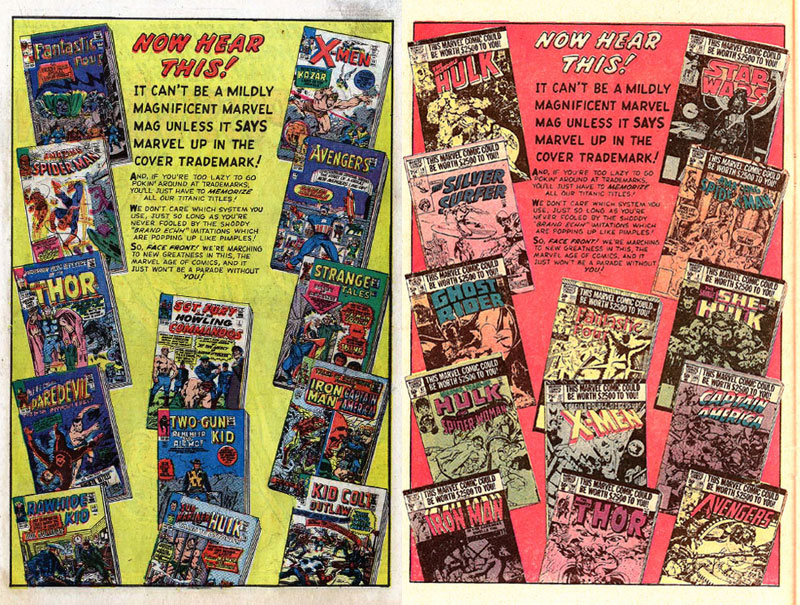
Separated at Birth: Now Hear This

Marvel House Ads 1965 and 1980
L: Marvel Comics house ad appearing in 1965 (this was in Fantastic Four Annual #3)
R: Marvel Comics house ad appearing in 1980 (this was in Battlestar Galactica #20)
(Click picture to Shooter-size)


Saturday Morning Cartoon: Bravia Bunnies


How'd they make that?!?:


Here's an extended making-of video. And a Flickr photoset of the filming.

If only Manhattan were really like this.


Friday, October 19, 2007

Friday Night Fights: Oh, Snap!

It's been Falcon Week over at Always Bet on Bahlactus, where the Big Mister B has laying down the awesome with some of the greatest cover appearances of Sam Wilson, the wingin'-est, swingin'-est cool cat ever to strap on a set of red mechanical feathers and soar into blazin' two-fisted action! Let's salute Mister Wilson as he temporarily escapes Dennis, that pesky neighbor kid, and instead helps out his erstwhile partner and comic book co-headliner, a little mild-mannered superhero you may have heard of called Captain America. But much like America on the world stage of today, big and bold as he is, Cap can't quite cut the mustard all by his lonesome...
Captain America and the Falcon #205 panel
All panels from Captain America and the Falcon #205 (January 1977), written and penciled by Jack Kirby, inked by John Verpoorten, colored by Michele Wolfman, lettered by Jim Novak


Luckily for Steve-O, the Man in Black Red 'n' White is there to pick up the cause of justice and right!:
Captain America and the Falcon #205 panel


Like meat and potatoes, like salt and tomatoes, they make the ultimate team...yeah, you heard me, Daredevil and Black Widow!
Captain America and the Falcon #205 panel


Wak! Pow! Cap takes the low road and Falc takes the high road, and the baddie'll be in dreamland before ye!
Captain America and the Falcon #205 panel


But a fast victory a boring comic makes, and Unca Jack knows better than that! Like Elton John, the villain's still standing, and flashin' his baby blues all over the place!
Captain America and the Falcon #205 panel


It's Falcon who comes up with the plan: just like Popeye, go for the eye eye!
Captain America and the Falcon #205 panel


Mama always told me not to hit guys with glasses, but lucky that the Falcon's mama always taught him to hit hard and ask questions about ocular wear later!:
Captain America and the Falcon #205 panel


And if you think the Falcon gives up after just one punch...well, you got another think comin', pallie! Yes sir!
Captain America and the Falcon #205 panel


When the bell rings at the end of the round, you better believe you should bet on the man with the wings: the soaring strength of the mighty Falcon!
Captain America and the Falcon #205 panel


Bahlactus hits 'em high and I hit 'em low.


Thursday, October 18, 2007

You and me and that red sweater

Life's funny, y'know. I have been feeling really under the weather, allergic and itchy and swollen and cranky and sick for the past several days, unable to work on my blog, not sleepin' any, hooves swolled up like big raw red tomatoes and jus' plain feelin' sorry for myself.

Then somebody does somethin' nice for me...like Jon did yesterday with his wonderful Bully sketch...an' I smile a li'l bit.

But by today I'm feeling sore and aching and still wanting to scratch scratch scratch my itchy bits so bad I can't think of anything else, going all "woe is me" and glaring up at the little dark raincloud gathering over my head.

And then today I get a package in the mail from my pal Miranda:

Miranda sent me a new red sweater!

It fits perfectly and it shows off my bullish chest and it has lovely cut-out sleeves like a big fuzzy vest and it is my favorite color of them all, RED! (She also sent me some cool BBC MP3s!)

And you know, when I put my new sweater on it feels like happy. I don't scratch and itch as much as I have the past couple days, and it is warm and snuggly and makes me feel all good inside and out.

I think therefore, tomorrow, armed with my new red sweater, and a new cheerful attitude, I'll be back to regular posting. People may say time heals all wounds, and Mama Bull has always said a hot bowl of chicken soup and some ginger ale in my Batman glass will make me feel better, but now I know the best cure for what ails ya: a beautiful red sweater!

Life's funny. But life is also good. Thanks, Miranda, for makin' me smile ear to ear and dance around in my new red sweater!


Wednesday, October 17, 2007

Crawling out of my sick bed to a wonderful surprise

Hullo folks hullo! I've been really under the weather the past couple days, which is why no posting since Monday, sorry! I had a very bad allergic reaction to a prescription medication which means I'll be fixing a stern stare at my personal physician Dr. Christina Yang pretty soon. In fact, if you were to ask the question "What's black and white and red all over?" these days, the answer would be me!

But doused liberally in Cortizone cream and feeling a little punch-drunk from all the Benadryl, I wobbled out of bed today to a fantabulous surprise: blogger Jon Cormier over at Hypnoray has produced a wonderful sketch of yours truly for his drawing class! Wow! I am flabbergasted and honored, and also in envious awe over his talented skills at accurately capturing my cheery, fuzzy nature. This was a better pick-me-up than one ever Merlin Olsen could deliver! Go over there and check it out, and don't miss the rest of his excellent blog! Thanks so much, Jon!


Monday, October 15, 2007

A Wodehouse a Week #25: Joy in the Morning

A Wodehouse a Week banner

'Good morning, good morning,' I said. 'I want a book.'

Of course, I ought to have known that it's silly to try and buy a book when you go to a book shop. It merely startles and bewilders the inmates. The motheaten old bird who had stepped forward to attend to me ran to form.

'A book, sir?' he said, with ill-concealed astonishment.

'Spinoza,' I replied, specifying.

This had him rocking back on his heels.

'Did you say Spinoza, sir?'

'Spinoza was what I said.'

He seemed to be feeling that if we talked this thing out long enough as man to man, we might eventually hit on a formula.

'You do not mean The Spinning Wheel?'

'No.'

'It would not be The Poisoned Pin?'

'It would not.'

'Or With Guns and Camera in Little Known Borneo?' he queried, trying a long shot.

'Spinoza,' I repeated firmly. That was my story, and I intended to stick to it.
from Joy in the Morning by P. G. Wodehouse

Today, 126 years ago in Guildford, Pelham Grenville Wodehouse was (prematurely) born, and not a moment too soon. Despite his solid English roots, he eventually proved to be, like Guildford's other most famous son, not quite of this world, at least when it came to his sublimely humorous and cheering literary output. Let's celebrate the quasquicentennial plus one of the Great Man by plucking one of my very favorite of his books of the ol' Wodehouse bookshelf, the wonderful and witty Joy in the Morning (1947). (Really, do it along with me—you shan't regret it!)

Like so many of Wodehouse's books, this one is also known by its American title of Jeeves in the Morning. It's perhaps not curious that the book was actually published in America the previous year (1946), almost nine months before its UK publication: remember Wodehouse was still very much reviled in the United Kingdom in the immediate post-war years following his genial but ill-advised broadcasts for the Nazis after he was taken prisoner of war. In 1947 he and his wife traveled directly from France to the United States, and he remained the rest of his days in Long Island.

Though the American publisher Doubleday can be commended on publishing Wodehouse's new novel first, I still have to quibble with their choice of new title. Sure, it makes a certain amount of commercial sense: gets the Jeeves name right up there, front and center, to ensure fast-moving sales right off the post-War bookstore shelves. But they're ignoring the very lyrical opening scene of the novel that gives the British version its title, which sets the stage by looking not forward to the future but back to the events Bertie and Jeeves appear to have only just fortuitously escaped from:
After the thing was over, when peril has ceased to loom and happy endings had been distributed in heaping handfuls and we were driving home with our hats on the side of our heads, having shaken the dust of Steeple Bumpleigh from our tyres, I confessed to Jeeves that there had been moments during the recent proceedings when Bertram Wooster, though no weakling, had come very near to despair.

'Within a toucher, Jeeves.'

'Unquestionably affairs had developed a certain menacing trend, sir.'

'I saw no ray of hope. It looked to me as if the blue bird had thrown in the towel and formally ceased to function. And yet here we are, all boomps-a-daisy. Makes one think a bit, that.'

'Yes, sir.'

'There's an expression to the tip of my tongue which seems to me to sum the whole thing up. Or rather, when I say any expression, I mean a saying. A wheeze. A gag. What, I believe, is called a saw. Something about Joy doing something.'

'Joy cometh in the morning, sir?'

'That's the baby. Not one of your things, is it?'

'No, sir.'

'Well, it's dashed good,' I said.

And I still think there can be no neater way of putting in a nutshell the outcome of the super-sticky affair of Nobby Hopwood, Stilton Cheesewright, Florence Craye, my Uncle Percy, J. Chichester Clam, Edwin the Boy Scout and old Boko Fittleworth—or as my biographers will probably call it, the Steeple Bumpleigh Horror.
How can you not read on from there? In my book, that's one of the great literary teases of all time, and I frantically bury my ringéd nose into the book and dive in to the narrative proper in order to find out what truly happened to that amazing cast of characters and what happens next. Really, it's the most convincing argument to turn the page since "Mr. Holmes, they were the footprints of a gigantic hound!"

Let me get this out of the way right at the start, or as close to the start as I've been able to fit it in: Joy in the Morning is a true work of genius. This is one of my very favorite of all Wodehouse books, and many critics who have a good deal more letters after their name have argued that it's his best, period. I chalk this up to Wodehouse's usual care and attention to writing and rewriting until the thing is pitch-perfect, and I need to read some of my Wodehouse biographies, because wonder if he spent his time in the captivity of the Germans planning and plotting Joy. If you've been reading these Wodehouse a Week reviews carefully you'll notice that while I've been complimentary about every one of his books, once in a while I point out when he misses an opportunity to tie a plot together or use a character to his fullest or to pace the thing at a leisurely stroll but without a single break in the action. Joy in the Morning has all that, and in spades. I've yet to work my way completely through the canon, but at least so far I've got to say this novel is the epitome of his writing. This is the Wodehouse novel you chuck at an alien interested in learning about the earth culture. Don't get me wrong: they're all good. But Joy is gooder than good...it's goodest.

The plot is probably one of his tightest and most intricate, but there's not a wasted scene or a spare moment that doesn't go somewhere. The portion I quoted at the top of this post—Bertie's adventures in a bookstore—aren't simply Wodehouse having a bit of fun at the expense of his bread-and-butter, but it occurs early on in the novel as the set-up to the whole goings-on. The bookstore clerk thinks perhaps instead of Spinoza (which Bertie was buying for Jeeves, of course), maybe Bertie wants Spindrift, a foul serious modern novel whose jacket "showed a female with a green, oblong face sniffing at a purple lily," and who should be the author of Spindrift but Bertie's ex-fiancée (one of the many), Florence Craye. Florence is delighted Bertie's apparently buying the book and autographs it with love to him. Florence is engaged to beefy bruiser G. D'Arcy "Stilton" Cheesewright, a former Eton schoolmate of Bertie's and now village police constable down at Steeple Bumpleigh, the county seat where resides Bertie's Aunt Agatha (she who chews on broken glass) and Uncle Percy. Being the jealous sort, Stilton suspects Bertie of putting the moves on Florence (the furthest thing from his mind). A book autographed with love to Bertie isn't going to help dissuade Stilton otherwise...

And really, it gets much more complicated after that, too much so to sum up in my review here, but Wodehouse never baffles or loses us, so skillful is his juggling of the varied and intertwined plots: Boko Fittleworth (another school chum of Bertie's) wooing Uncle Percy's daughter Nobby (short for Zenobia) against Percy's wishes, Percy's need to meet in private to conduct a lucrative business deal with American shipping magnate J. Chichester Clam, Nobby's pesky brother, the Boy Scout Edwin, who is so far behind on his daily good deeds that he's doing last Thursday's today, a country fancy dress masquerade ball, a country cottage that burns to the ground five minutes after Bertie enters it for the first time, a misdirected brooch, an empty tube of anchovy paste, a policeman's uniform, and of course Jeeves, calmly reining over it all and solving the problem casually and directly like a conjurer giving no sign that the solution requires any effort at all.

Every element is intricately connected to the others and drives the rest of the characters like clockwork gears meshing against one other. To continue the clock metaphor, this is a plot that's wound up tight as a watch spring, and while Wodehouse never lose control of it, he does show us exactly what happens when the tension is taken just to the breaking point and then unwinds, very rapidly, in an extended but breezily joyous mid-point scene where Bertie attempts a daring midnight burglary on Uncle Percy's estate of Steeple Bumpleigh. He's (reluctantly) giving Boko a chance to chase him away and win favor with Uncle Percy, but it all goes awry very quickly as every single character in the book arrives on the garden lawn in quick succession to see what's going on. It's farce, yet, but it's amazingly well-timed and paced: just as the tension from the entrance of one character starts to wane, another one enters and cranks up the action again. Remember a couple weeks ago when I mentioned that The Girl on the Boat didn't quite have its climatic nighttime alarums and excursions scene in the right place? Though I didn't remember it specifically at the time, Joy in the Morning has precisely the right mid-book placement for this scene—ifd it was a five-act Shakespeare comedy this would be Act III. It's one of my favorite scenes in English literature, really—I don't think anyone outside of The Marx Brothers in A Night at the Opera twelve years earlier has pulled off such a well-timed escalation of entering characters. Messrs. Groucho et al did it with physical space: dozens of characters jammed into a tiny steamship cabin. On the printed page Wodehouse can't go for precisely that same comedy (I do remember he has fun in steamship cabins in his The Luck of the Bodkins, which I really do need to re-read one of these weeks) so he substitutes the humor of the characters: each acting and reacting to each other and the suspected burglar while Uncle Percy fumes to a boiling point in the background.

Add to all that some of the loveliest Wodehouse passages in print. Go ahead, read some of these aloud, or get some friends to act them out with you—you'll see how lyrically and rhythmically Wodehouse polishes his prose so that it's like, as he would put it, a musical comedy without the music:
'Ah, Jeeves,' I said.

'Good morning, sir,' he responded. 'A lovely day.'

'Lovely for some of us, perhaps, Jeeves,' I said coldly, 'but not for the Last of the Woosters, who, thanks to you, is faced by a binge beside which all former binges fade into insignificance.'

'Sir?'

'It's no good saying 'Sir?' You know perfectly well what I mean. Entirely through your instrumentality, I shall shortly be telling Uncle Percy things about himself which will do something to his knotted and combined locked which at the moment has slipped my memory.'

'Make his knotted and combined locks to part and each particular hair to stand on end like quills upon the fretful porpentine, sir.'

'Porpentine?'

'Yes, sir.'

'That can't be right.'
Or, Bertie musing on his Uncle Percy:
...And thought with advancing years our relations had naturally grown more formal, I had never been able to think of him without getting goose pimples. Given the choice between him and a hippogriff as a companion for a walking tour, I would have picked the hippogriff every time.
...whose impatience with Bertie leads to this semantic exchange in which Bertie tries to convince a tipsy Uncle Percy to let Boko marry Nobby:
'He could support Nobby in the style to which she is accustomed.'

'No, he couldn't. Ask me why not.'

'Because I'm jolly well not going to let him.'

'But he loves, Uncle Percy.'

'Has he got an Uncle Percy?'

I saw that unless proper steps were taken, we should be getting muddled.

'When I say he loves, Uncle Percy," I explained, 'I don't mean he loves, verb transitive, Uncle Percy, accusative. I mean he loves, comma, Uncle Percy, exclamation mark.'

Even while uttering the words, I had a fear lest I might be making the thing a shade too complex for one in the relative's condition. And I was right.

'Bertie,' he said, gravely, 'I should have watched you more carefully. You're tighter than I am.'

'No, no.'

'Then just go over that observation of yours again slowly. I would be the last man to dispute that my faculties are a little blurred, but—'

'I only said that he loved, and shoved an "Uncle Percy" at the end of my remarks.'

'Addressing me, you mean?'

'Yes.'

'In the vocative, as it were?'

'That's right.'

'Now we've got it straight. And where does it get us? Just where we were before.'
There's of course the wonderful sight of Jeeves reciting more animal poetry as Bertie parts from him for the nonce:
'I shall miss you, Jeeves.'

'Thank you, sir.'

'Who was the chap who was always beefing about losing gazelles?'

'The poet Moore, sir. He complained that he had never nursed a dear gazelle, to glad him with its soft black eye, but when it came to know him well and love him, it was sure to die.'

'It's the same with me. I am a gazelle short. You don't mind me alluding to you as a gazelle, Jeeves?'

'Not at all, sir.'
...but the capper is when Wodehouse makes a callback to an earlier reference that has baffled Bertie:
'...when I think of what will happen if Stilton cops me while I am draped in that uniform, it makes my knotted and combined locks...what was that gag of yours?'

'Part, sir, and each particular hair—'

'Stand on end, wasn't it?'

'Yes, sir. Like quills upon the fretful porpentine.'

'That's right. And that brings me back to it. What the dickens is a porpentine?'

'A porcupine, sir.'

'Oh, a porcupine? Why didn't you say that at first? It's been worrying me all day.'
You've got to excuse me for quoting so much more than I even usually do from a Wodehouse book—there are gems here on every page spread, and I could happily quote until the cows come home. Which reminds and brings me to another interesting observation: this Wodehouse masterpiece just happens to be missing two usual Wodehouse literary tricks and plot devices that usually drive the action: there is no Silver Cow Creamer or the like to be stolen back and forth, and there is no possession or fashion of Bertie's at which Jeeves expresses dislike and withholds the solution to the problem until it is disposed of. They're both wonderful devices, but I think Joy in the Morning surpasses so many of the other Wodehouse comic novels by not needing them. There's physical objects that move the plot along (a signed book, a lost brooch, a policeman's uniform, a burnt-down cottage), but the book is not centered on their existence: everything happens because of the actions and personalities of the characters. Wodehouse's physical prop comedy is wonderful, but here he shows what a transcendent novel he can produce without relying on them. It's sheer joy—one of his most aptly-titled books.


Of course because I love it so, I have more than one edition of Joy in the Morning: a mass market UK Coronet paperback reprint published in the 1970s—badly printed with many typographical errors and missing quote marks, the British Everyman's Wodehouse hardcover uniform edition, a lovely if battered second edition Herbert Jenkins UK hardcover with a vibrant Frank Ford cartoon jacket, but I'm most fond of a dust-jacketless version of the same Herbert Jenkins hardcover (the one I'm reading in the photo). It's battered and bruised and bent. It shows clear signs of having been discarded from its former home in a lending section of Boots the Chemist: a green "Boots Booklovers Library" sticker is mostly still affixed to the front, and there's a small metal-ringed punched hole in the top of the spine. Things with rings through them are dear to my heart, but I especially love this copy because it is the first first edition of Wodehouse I ever bought when I was starting my collection. I remember distinctly buying it in a used bookshop outside Kew Gardens in London during my very first trip there, in 1983. I know as a former lending library book it's had lots of hands on it but I'm very happy it's in my hooves now. It feels like it's home. You can get your own hooves on a copy of Joy in the Morning by clicking on the usual Amazon link to the right. And, if you liked the sound of your own voice when you read the above bits aloud but wished you could do a better British accent, then you might enjoy the BBC Radio 4 full-cast dramatization of Joy in the Morning, a three-and-a-half hour radio play with Sir Michael Hordern as Jeeves and Richard Briers as Bertie, one of several Beeb audio adaptations of the Jeeves stories. It's no available in the US, but you can order it from England's Amazon.co.uk here The audio version is almost pitch-perfect—the actor playing Edwin the Boy Scout is an adult woman whose voice gets pretty annoying after a while—but that's a small price to pay for hearing Briers and Hordern in this world of delight.

But whichever you do, or both, or neither, please raise a cup of tea or a gin and tonic with me and salute Mister Wodehouse on his 126th grand birthday. Happy Birthday, Plum—and thanks for all the joy.

A Wodehouse a Week Index.

Sunday, October 14, 2007