Saturday, October 06, 2007

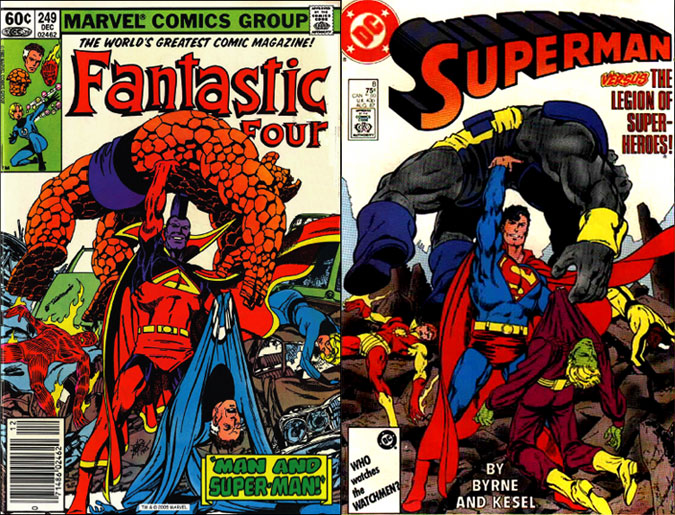
Separated at Birth: Lift me up from the broken hearted

FF #249, Superman v. 2 #8
L: Fantastic Four #249 (December 1982), art by John Byrne
R: Superman v.2 #8 (August 1987), art by John Byrne and Karl Kesel
(Click picture to Blok-size)


(Read a fun-stuffed Dave's Long Box post about Superman #8.)

Saturday Morning Cartoon: And She Was


"And She Was" by Talking Heads (1985), directed by Jim Blashfield


Friday, October 05, 2007

Friday Night Fights: Girl Fight Tonight!

FF #332 panel
All panels are from Fantastic Four #332 (November 1989), written by "John Harkness" (Steve Englehart); art by RIch Buckler, Romeo Tanghal, and George Roussos; letters by Bill Oakley

Girl fight tonight!
Girl fight tonight!


FF #332 panel
Look, there she is
I'm going to kick her blonde butt
Hey girl, I wanna talk to you


FF #332 panel
I've seen the way that you check him out
When you think I'm not around
Mentally undressin' him
Whoa-oh, tryin' to shut me down


FF #332 panel
Well, you know last night he told me
All those nasty things that you said
You asked him if he gets lonely
Now you're asking to be dead!


FF #332 panel
Girl fight tonight!
Shoo-be-do-bop and a shoo-bop-a run away
Revenge is gonna be so sweet


FF #332 panel
Girl fight tonight!
Shoo-be-do-bop and a shoo-bop-a run away
Your lips are gonna kiss the street


FF #332 panel
You only want him 'cause I want him
Back off, girl, or else
Girl fight tonight!


FF #332 panel
I hate the way that your sweater fits (tight)
I hate your baby talk
I can read your dirty mind
I watch you watch him walk


FF #332 panel
When you told him he looked like Rob Lowe
Well, that was the last straw
So now I have to tell him
That you wear a padded bra!


FF #332 panel
Girl fight tonight!
Shoo-be-do-bop and a shoo-bop-a run away
Ooh, we're gonna have some fun


FF #332 panel
Girl fight tonight!
Shoo-be-do-bop and a shoo-bop-a run away
Blood and mascara will run


FF #332 panel
We'll see how long your tan lines last
When you're in a body cast
Girl fight tonight!


FF #332 panel
All in love is fair
She'll rip out your hair
Now I'm declaring war
You know she's killed before
'Cause I'm a lover and a fighter...bitch!


FF #332 panel
Shoo-be-do-bop and a shoo-bop-a run away
Revenge is gonna taste so sweet
Girl fight tonight!
Shoo-be-do-bop and a shoo-bop-a run away
Your lips are gonna kiss the street


FF #332 panel
You only want him 'cause I want him
Back off, girl, or else
Girl fight tonight!


Then, Franklin runs away crying to Reed, who rushes in and breaks up the big bad catfight. No kiddin'.

Oh, and did you notice the sound effect in the panel where Crystal came back in the window?


FF #332 panel
Best...sound effect...ever.


Now fire this up and read it again!:


"Girl Fight Tonight!" by Julie Brown (1987)


(Bahlactus would never hit a girl.)

So, Blogger, it's come to this.

Blogger apparently wants to make it difficult for me to comment on other blogs:


You may have won this one, Mister Blogger, but I'll be back with reinforcements to untangle your indecipherable verification letters!


Thursday, October 04, 2007

A very quick tour of the Baxter Building

Did this morning's post leave you with an eager need to see more of the Baxter Building's various floors and sections?

Then let's take a very quick tour of the Baxter with its most famous resident, Benjamin Grimm:
FF #242 panel
Panel from Fantastic Four #242 (May 1982), art by John Byrne


Why, thank you, Thing!


Our house is a very very very fine house/With a portal to the Negative Zone on the thirty-fourth floor...

Sure, most of us have photo albums of our house. Some of us might even have lovely oil paintings of our baronial estates. But how many of us have blueprints of where we live regularly published in comic books? Unless your last name is Richards, Storm, or Grimm...then not you, bub!

Fantastic Four #3 panel
From Fantastic Four #3 (March 1962), art by Jack Kirby


Fantastic Four #6 panel
From Fantastic Four #6 (September 1962), art by Jack Kirby


Fantastic Four Annual #1 panel
From Fantastic Four Annual #1 (1963), art by Jack Kirby


Fantastic Four #201 panel
From Fantastic Four #201 (December 1978), art by Keith Pollard and Joe Sinnott


Fantastic Four #249 panel
From Fantastic Four #249 (December 1982), art by John Byrne


OHOTMU #4 page
OHOTMU #4 page
From The Official Handbook of the Marvel Universe #4 (April 1983), art by Eliot R. Brown


Remember: save this post for future reference!...

...just in case you're ever lucky enough to visit the fabulous Baxter Building in beautiful midtown Manhattan:


Wednesday, October 03, 2007

Reed Richards: Math Genius!

FF #133 panel
Panels from Fantastic Four #133 (April 1973), written by Roy Thomas and Gerry Conway, art by Ramona Fradon, Joe Sinnott, and Stan Goldberg, lettering by John Costanza

1900+75=1973. To Reed, at least. Well, it's a good thing that his job doesn't depend on being precise with numbers...I mean, it's not rocket science, is it?

FF #? panel
(Flashback) panels from Fantastic Four #261 (December 1983), written and drawn by John Byrne, colors by Glynis Wein, lettering by Jim Novak

Oh. Well, that explains that.

Tuesday, October 02, 2007

Extreme Makeover, Marvel Universe Edition

Dazzler #22
Rogue, 1982 edition

Uncanny X-Men #274
Rogue, 1991 edition


Images from the invaluable Grand Comic Book Database


Monday, October 01, 2007

A Wodehouse a Week #23: The Girl on the Boat

A Wodehouse a Week #23

1922: You and I were doing the jitterbug on the wing of Lindy's plane with Zelda Fitzgerald knee-deep in a vat full of bathtub gin, but P. G. Wodehouse was writing, writing, writing. And he had a good head start on it, too: I flipped to the copyright page and double-checked: yes, The Girl on the Boat was published in 1922. Off the top of your head you almost want to say "Yeah, that's one of Wodehouse's early novels." But keep in mind: by this point he had been a published author for twenty years. Yah boo! Take that, Miss J. K. Rowling-come-later!

Okay then, let's call The Girl on the Boat (American title: Three Men and a Maid) one of Wodehouse's earlier novels. Wodehouse had been publishing his school stories twenty years ago; his romances started more or less ten years before. He's sharper, tighter, and funnier than he was in Love Among the Chickens and The Man Upstairs, but he's not quite at the height of his skills and career. Jeeves had only been "born" a few years ago; Blandings had premiered seven years ago but still had its glory ahead of it. In short, this is far from unpolished Wodehouse, but it's still a Wodehouse in formation: a fairly standard (for him) love story: Brit boy (Sam Marlowe) meets American girl (Wilhelmina "Billie" Bennett), but girl is engaged to his own cousin. And, in the course of the novel, becomes engaged to two other men as well. Here in the modern twenty-first century that's Page 6 fodder, but back in the roaring twenties it's charming as heck, as is the scene where Sam first meets (and is enamored of) Billie. As usual, there's music in the air and love on the wing, and a clever little twist to keep it all from being too saccharine:
Nature abhors a vacuum. Samuel Marlowe was a susceptible young man, and for many a long month his heart had been lying empty, all swept and garnished, with "Welcome" on the mat. This girl seemed to rush in and fill it. She was not the prettiest girl he had ever seen. She was the third prettiest. He had an orderly mind, one capable of classifying and docketing girls. But there was a subtle something about her, a sort of how-shall-one-put-it, which he had never encountered before. He swallowed convulsively. His well-developed chest swelled beneath its covering of blue flannel and invisible stripe. At last, he told himself, he was in love, really in love, and at first sight, too, which made it all the more impressive. He doubted whether in the whole course of history anything like this had ever happened before to anybody. Oh, to clasp this girl to him and—

But she had bitten him in the arm. That was hardly the right spirit. That, he felt, constituted an obstacle.
Let's be fair to Billie (and Wodehouse); his heroine isn't a werewolf (although what a Wodehouse book that woulda made, huh?)—she's actually carrying a nippy little dog by the disgustingly cute name of Pinky-Boodles. Such a sugary cloying name is usually the province of cutsey-wootsy Madeline Bassett from the Bertie and Jeeves stories, but silly dog names aside, Billie is lovely and loving and worthy of being loved. Sam pursues her through the remainder of the novel, from on board a ship making a trans-Atlantic crossing, back to the British country estate where she's staying, and he's not above being a little cutesy-wootsy himself when he daydreams about her:
Her friends called her Billie. He did not blame them. It was a delightful name and suited her to perfection. He practised it a few times. "Billie ... Billie ... Billie...." It certainly ran pleasantly off the tongue. "Billie Bennett." Very musical, "Billie Marlowe." Still better. "We noticed among those present the charming and popular Mrs. 'Billie' Marlowe."
Of course, a P. G. Wodehouse novel wouldn't be worth its colorful dust jacket if impediments to the course of true love didn't rear their ugly if convenient heads about a third of the way through the book. It's more convenient to just say Billie's ticked off at Sam rather than try to explain it—see, he was doing a blackface comedy routine for a talent show on board the ship, except his cousin, who was to accompany him on the piano, ducked out, leaving Sam alone and corked-up on stage and looking pretty darn foolish...look, it doesn't matter! What matters is they spend the next third of the book sniping at each other with a little more venom than Wodehouse usually gives his temporarily feuding couples. The sequence below is especially reminiscent of, say, the fussin' and a-fightin' Beatrice and Benedick from Shakespeare's Much Ado About Nothing:
'What makes you call England a savage country?' demanded Sam, a staunch patriot, deeply stung.

'What would you call a country where you can't get ice, central heating, corn-on-the-cob, or bathrooms? My father and Mr Mortimer have taken a house down on the coast and there's just one niggly little bathroom in the place.'

'Is that your only reason for condemning England?'

'Oh no, it has other drawbacks.'

'Such as?'

'Well, Englishmen, for instance. Young Englishmen, in particular. English young men are awful! Idle, rude, conceited, and ridiculous.'

Marlowe refused hock with a bitter intensity which almost startled the old retainer, who had just offered it to him, into dropping the decanter.

'How many English young men have you met?'

Billie met his eye squarely and steadily. 'Well, now that I come to think of it, not many. In fact, very few. As a matter of fact, only...'

'Only?'

'Well, very few,' said Billie. 'Yes," she said meditatively, 'I supposed I really have been rather unjust. I should not have condemned a class simply because...I mean, I suppose there are young Englishmen who are not rude and ridiculous?'

'I suppose there are American girls who have hearts.'

'Oh, plenty.'

'I'll believe that when I meet one.'
Oooooh, PWNED! Ouch, that's cold. (And I do believe that's the first time on the internet that the word pwned has been used in a review of a P. G. Wodehouse novel.) Well, like Beatrice and Benedick, but without all the tennis ball jokes, you know this will have a happy ending, even if it takes a thwarted attempt by Sam to steal Pinky-Boodles which leads him to hide within a suit of armor whose helmet gets stuck on his head.

Billie is all very pretty and pleasant, but by far a more unique and entertaining female lead is Jane Hubbard, big game hunter. Yes, you read that right: Jane Hubbard, big game hunter: rootin'-tootin' take-no-prisoners modern girl who stalks, hunts to ground, and captures furry animals with the skill of Frank Buck or Ross Allen. Here's one of Wodehouse's wonderful descriptions of this she-gal warrior woman:
Jane Hubbard was a splendid specimen of bronzed, strapping womanhood. Her whole appearance spoke of the open air and the great wide spaces and all that sort of thing. She as a thoroughly wholesome, manly girl, about the same age as Billie, with a strong chin and an eye that had looked leopards squarely in the face and caused them to withdraw abashed into the undergrowth, or wherever it is that leopards withdraw when abashed. One could not picture Jane Hubbard flirting lightly at garden parties, but one could picture her very readily arguing with a mutinous native bearer, or with a firm touch putting sweetness and light into the soul of a refractory mule. Boadicea in her girlhood must have been rather like Jane Hubbard.
In the world of Wodehouse, just like in the music videos of Miss Paula Abdul, opposites attract, and Sam's milquetoast cousin Eustace Hignett immediately falls in love with Jane. Too bad he's engaged to Billie, but that's half the fun of a Wodehouse book, isn't it—the elaborate square dance of courting that always changes partners halfway through the book? Eustace is so smitten he waxes moonily:
Eustace Hignett finished undressing and got into bed. With a soft smile on his face he switched off the light. There was a long silence, broken only by the distant purring of engines. At about twelve-thirty a voice came from the lower berth.

"Sam!"

"What is it now?"

"There is a sweet womanly strength about her, Sam. She was telling me she once killed a panther with a hat-pin."

Sam groaned and tossed on his mattress.

Silence fell again.

"At least I think it was a panther," said Eustace Hignett, at a quarter past one. "Either a panther or a puma."
For my money there isn't enough Jane Hubbard in the book, even though she gets her chance to shine in the climatic final chapters where burglars are believed to be prowling the country estate and Jane shoots her elephant gun through the manor house's doors. I will pause a moment before repeating the sheer awesomeosity of that sentence: Jane shoots her elephant gun through the manor house's doors. be still, my little fluffy heart. Sadly, Jane does not appear in any other future Wodehouse books, even though I bet he could have made an entire series of her firing her elephant gun wildly around Barribault's restaurant or Blandings Castle or the Drones Club.

That climatic scene: funny and frenzied, yes, but I read it and said to myself, Wodehouse isn't quite at his prime yet. He would later move the frequent "nighttime alarums and excursions" scenes to the middle of the book rather than the end, using the close of what would be the third act (if this were a Shakespeare play) to whip up a frenzy and spin couples together and apart, setting them up in what only looks like a confused and willy-nilly (but is actually planned to the finest detail) fashion for the latter third of the book. There's nothing wrong with the structure of the book, of course, but I'd bet pounds to peanuts that an older Wodehouse would have moved the nighttime scene of confusion and elephant guns to the middle of the book.

But that's a minor quibble. This isn't one of Wodehouse's finest romances, but it's got a lot of fun in it, and it's interesting to see some of the tricks and clever details Wodehouse would later refine even more precisely in this between-the-wars novel, like a very Jeeves-ish butler who's unfazed by his master's declarations that he's dying (he's actually just got a silver of lobster-shell stuck in his tongue), and who hatches an elaborate plot for Sam to recapture the heart of Billie. And how you not love this lovely and lyrical meta-aware opening for Chapter 4?:
It was the fourth morning of the voyage. Of course, when this story is done in the movies they won't be satisfied with a bald statement like that; they will have a Spoken Title or a Cut-Back Sub-Caption or whatever they call the thing in the low dens where motion-picture scenario-lizards do their dark work, which will run:

AND SO, CALM AND GOLDEN, THE DAYS WENT
BY, EACH FRAUGHT WITH HOPE AND YOUTH
AND SWEETNESS, LINKING TWO YOUNG
HEARTS IN SILKEN FETTERS FORGED BY THE
LAUGHING LOVE-GOD.


and the males in the audience will shift their chewing gum to the other cheek and take a firmer grip of their companions' hands and the man at the piano will play 'Everybody wants a key to my cellar' or something equally appropriate, very soulfully and slowly, with a wistful eye on the half-smoked cigarette which he has parked on the lowest octave and intends finishing as soon as the picture is over. But I prefer the plain frank statement that it was the fourth day of the voyage. That is my story and I mean to stick to it.
The Girl on the Boat movieAnd...irony of ironies, they did do this story in the movies, starring Norman "Big in Albania" Wisdom as Sam, Millicent Martin as Billie and perennial Wodehouse actor Richard Briers as Eustace. In the spirit of learning a lot more about Wodehouse and his works in the course of the Wodehouse a Week project, I never knew such a movie existed, and now my driving goal is to find a copy. (It's available as a UK Region 2 DVD, which means I'd better step up my plan of getting a region-free DVD player pretty soon!) I'll let you know what it's like if and when I get a chance to watch it.


In the meantime, reading it is just dandy. I read The Girl on the Boat in my Vintage UK paperback edition, the only edition I have of this novel. That edition's out of print (sob) but you're in luck because only last week Overlook Press reissued Girl in its lovely uniform Collectors' Wodehouse edition. How new is it? Even I don't have this edition yet, showing Queen o' My Heart Jane Hubbard fearlessly removing a shard of lobster shell from the tongue of Billie's father. Be careful eating your lobster while reading your copy: big game hunter Jane's busy scratching me behind the ears while she tells me about running with the bulls in Pamplona, so she can't come to your rescue if you cut your tongue.


Sunday, September 30, 2007

Ten of a Kind: And I'm free...free fallin'


(More Ten of a Kind here.)


Saturday, September 29, 2007

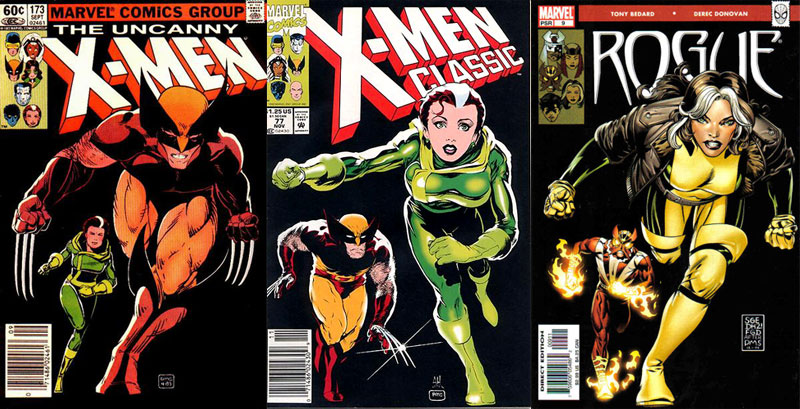
Separated at Birth: Ya running and ya running/And ya running away/But ya can't run away from yourself

Uncanny X-Men #173, X-Men Classic #77, Rogue #9

L: Uncanny X-Men #173 (September 1983), art by Paul Smith
M: X-Men Classic #77 (November 1992), art by Adam Hughes
R: Rogue #9 (May 2005), art by Scott Eaton and Dan Hillsman
(Click picture to honey-and-magnolia-size)


Saturday Morning Cartoon: Bimbo's Initiation


"Bimbo's Initiation" (1931), directed by Dave Fleischer,
animation by Myron "Grim" Natwick,
and featuring the early "French poodle" Betty Boop design
.

Say, why did Bimbo disappear from the Betty Boop cartoons? The startling answer here. And say...wanna be a member?


Friday, September 28, 2007

Friday Night Fights: Time waits for no man, and it won't wait for Reed

I love time travel stories.

No, no, I really love time travel stories. If time travel stories were a girl, I'd marry them. (Also, if they were Keira Knightley.) I loves me some era-hoppin', clock-turnin', calendar-flippin', grandfather-killin' stories with the fierce passion of John Wilkes Booth as he tripped over me shouting "Sic Semper Tyrannus," and firing his handgun wildly, upset about his copy of Incredible Hulk #5, apparently.

Star Trek TNG: Time SquaredI like historical time travel stories, where you get to meet Jesse James or Teddy Roosevelt or Clara Bow. I really like self-looping and -referential ones: where the traveler overlaps his own life and we see the effects of his own past actions on himself rather than just Julius Caesar or Fatty Arbuckle or Duke Kahanamoku. Think Back to the Future, Part Two (where two Marty McFlys stretch the special effects budget and double Michael J. Fox's rich-as-Croesus salary), or Star Trek: The Next Generation's "Time Squared," which pits Picard versus Picard for the Enterprise's annual "Make-It-So-Off" competition.

But what I really love are time travel stories where events appear chronologically out of sequence to the general observer but in fact have a logical forward-moving storyline from the POV of the time travelers. F'r instance: where the heck did that Data-head come from at the beginning of Star Trek TNG's Time's Arrow? (Data would lose his head in his own future but back in the past). How come The Doctor and Martha don't recognize either Queen Elizabeth I or Sally Sparrow? (Because those meetings occur in the Doctor's own future, which is the past for those two who have met him). When I first flipped open 52 Week 19, I was all thrilled and excited, because (as I declared loudly to the world) "Booster's back, Baby!" And with the time-hopping assistance of Rip Hunter, Booster's story no longer needed to continue chronologically...for us, that is. I wanted to see Skeets chasing Booster and Rip throughout time...more specifically, throughout the 52 weeks...which means we would have seen them pop up through out the series, out of sequence, every few issues. A Skeets/Booster/Rip appearance in, say, issue #32 might be followed by one in issue #37...that occurred before the one in #32. Only when you have the whole series could you follow along and put all the pieces together in logical time-traveler POV chronological order. When I realized, however, that this wasn't gonna happen (Booster didn't pop out of time until quite close to the end of the series), I was a little disappointed. I love Easter eggs like that, which reward careful reading, re-reading, and flipping around to link the segments together. I do think DC dropped the ball by not giving us short snippets of Booster leaping around the fifty-two weeks, but as the new Booster Gold series is pretty fun and seems like it might pull out that old but irresistible trick at some point, all is forgiven, Johnny DC.

FF #352 And anyway, as I suddenly remembered with a tiny light bulb going on over my fuzzy little head, somebody did a story like that already. And that somebody was the totally freakin' awesome Walt Simonson. And that story was the senses-shattering time-twisting Fantastic Four #352. And that this FF is one of the most fun comics, ever, and maybe I oughta tell you a little bit about it.

"But what," you ask, "has that got to do with the triumphant, fast-smashin', sucka-punchin' return of Bahlactus's Friday Night Fights, Bully?" you query me, and I shake my head and smile at your naive question. It's because, quite simply, dear readers, FF #352 features the mind-blowing spectacle of Reed Richards and Victor von Doom slugging it out mano a mano as they leap around in time. Or, as Unca Walt tells us, without a sliver of hyperbole:
FF #352 panel


Let's peer in on our kooky kwartet, shall we?

FF 352 double-page spread
Artwork on this and further panels are from Fantastic Four #352 (May 1991), written and drawn by Walt Simonson, coloring by Marie Javins, lettering by Bill Oakley
(Click this picture to Big Ben-size)


It is exactly 1:04 AM. Long past my bedtime, but both Reed and Doom get to stay up late and watch Conan 'coz they're wearing Doom's "personal time sequencers" that allow them to skip back and forth in time anywhere within one half-hour of your origin point. Much like those pesky aliens who gifted Ralph Hinkley Hanley with the super-suit, Doom doesn't provide Reed with any instruction on how to use the time sequencer. But there's a reason why no VCRs in the Baxter Building ever flash "12:00"...Reed can figger out any machine in a split-second! By zipping back in time two seconds, Reed's able to land the first punch of this powerhouse fight, popping out of the space-time continuum just in...er, time to clock Doom a big rubbery sucka punch with Doom's collectible Mjolnir replica. Booyah, Doctor Doom!
FF #352 panel


But Reed is not all rubber and no silicon chip: he's got a plan, Stan, and he puts it in action by flicking ahead from 1:05 AM (see the green time box in the lower left-hand corner for the "real universe" time) to 1:08 AM (the white circular time balloon shows where Reed and Doom are heading to).
FF #352 panel


Turn the page and for bashful Benjy Grimm the clock ticks along placidly to 1:06 AM so you can read his emotional subplot with ex-She-Thing Sharon Ventura, and there! On the right side of the page pop Doom and Reed...but golly, what they're saying and doing doesn't following logically from the previous page, does it?
FF #352 panel


In fact, try to read this like a normal comic book and you'll quickly be confused. The Thing storyline progresses normally at a forward-clock movement per page pace, but the Doom/Reed panels seem to be disjointed and out of order! The dialogue doesn't seem to make sense and Reed is suddenly clad in some sort of armor he wasn't wearing on the previous page...oh wait, that's right! They're time-traveling! Don't read the Doom/Reed pages in comic book order; instead, follow their time travels using the minutes at the bottom right corner of the page!

Armed with this knowledge, flip back a page and note that Doom and Reed set out from 1:05 heading to 1:08. Flip through the comic until you spot the "real world" 1:08 (a few pages forward, in the bottom left green box), and there's where Doctor Doom has landed:
FF #352 panel


But Reed's not here? Tricky, tricky, Doc Richards! Doom heads off for 1:25 AM, and so should we, flipping forward into the future where he catches Reed unstable-moleculed-handed, arming himself (and armoring himself up!) in Doom's weaponry room of the not-too-distant future! But Doom catches up with him and off they head for 1:33 AM:
FF #352 panel


Plaang! Pound! Fzzzip! Foom! Here's the throwdown that Bahlactus has charged me with presenting to you good folks. It's not a good idea to have fistfights at 1:33 in the morning (some people are tryin' to sleep, you know!), they're not there long, heading back in the flash of an eye to 1:06 AM.

FF #352 panel

To follow them, you and I flip back a handful of pages until you find the green real world time of 1:06, and the story continues there. Now that panel from 1:06 AM makes sense, don't it? And am I not telling the truth when I opine with every bean in my body that this is one of the most fun comics, ever?

Of course, if you're following Doom and Reed, the Thing storyline will seem out of sequence. That's why this comic utterly rewards careful reading and re-reading: you need to read it at least twice (once following Reed and Doom, the other time to follow the rest of the FF), and then you'll be so gap-mouth slack-jawed freakin' blown away by teh ZOMG awesum that is the wild and wacky mind of Walt Simonson that you'll wanna read it again and again and again...not for nothing is this cover-blurbed as
FF #352 panel


Oh, and my second favorite part?

FF #352 panel

Reed lures Doom to 1:13 AM, just in time for him to pop out of thin air and be blasted by a robot that's fighting The Thing. Now that's thinking fourth-dimensionally, Reed!

But what's my favorite part?

FF #352 panel

At 1:34 AM, Reed goads Doom into blasting him point blank, but our Elastic Exemplar deflects the power of the blast using his time sequencer, sending the blast to 12:33 AM and himself to 1:20 AM. But wait a ever-luvin' minute...the story started at 1:00 AM...just where the Sam Scratch did Reed send the energy blast?

The ultra-cool answer: he sent it so far back that it went into a totally different comic book:
FF #352 panel


Reed Richards deflected an energy blast through time in Fantastic Four #352 and it wound up in Fantastic Four #350 (neatly skimming over FF #351, which was a fill-in issue).

...

(my head explodes)


(tucking the fluff back into my head)

Okay. Let's pull FF #350 out of the longbox and take a look at that. Doom has captured the Fantastic Four and placed each one in an impossible-to-escape trap. Sue's in a room filled with gas that keeps her unconscious, Johnny's apparently in a hotel suite with free adult movies, and Reed? Reed's in a dungeon cell so impregnable that there is not a single hole for Reed to stretch and slither out of. In short, Reed is trapped and we'll never see him again:
FF #352 panel
Artwork on this and the next panel are from Fantastic Four #350 (March 1991),
written and drawn by Walt Simonson, inks by Al Milgrom, coloring by Brad Vancatta, lettering by Bill Oakley


Oh, until he appears a few pages later telling Doom that he dug his way out with a belt buckle.
FF #352 panel


Cheat! shouted the amassed internet, or whatever CompuServe forums and AOL chat rooms existed in 1991, back when everyone's favorite comic blogs were just a twinkle in the eye. That seems like a careless excuse for an escape, hardly worthy of either Reed (not clever enough) or Doom (too sloppy a deathtrap). But now that we've read, out of page sequence, FF #352, we know the rest of the story: Reed was lying about the belt buckle. His real escape was facilitated by the deflected energy future-Reed sent back to 12:33 AM blasting down the walls of his prison. In short, like Bill and Ted, Reed escaped certain death by reminding himself later to save himself from certain death.

Right now, you're a Grinch or a communist if you're complaining in any way, shape or form about this story. If you still retain your senses and can hold in your drool instinct, however, you might ponder aloud: "Well, why didn't Walt show us Reed escaping from his trap?"

And the answer to that one is: he did...right on the cover of FF #352 (note the real-time counter "12:33 AM" in the corner):
FF #352 panel


(head goes 'splodey again)

Reed Richards: game, set, and match. But Walt Simonson for the win.

One hundred ten seconds ago, you clicked on a link from the Mighty Bahlactus that sent you here to my blog. Thirty-three seconds from now, I will be finishing writing this blog entry up and sending the link to Bahlactus. Yesterday, he replied with a thank-you note.

And for a dandy look at FF #350 ("The One Where The Energy Bolt Wound Up"), well, hop feet first into the joy that is Dave's Long Box!